
All Articles

International Customer & Buyer Testimonials
“Our goal for this year’s World Gas Conference was to put on a world-class event in a world-class city. We exceeded that goal. The Walter E. Washington Convention Center is the most impressive venue that has hosted any of our conferences. Destination DC and Events DC have truly exceptional, friendly and professional teams. All of our thousands of attendees were thrilled with being in Washington, DC for this year’s conference.” – Jay Copan, WGC 2018 “Washington, DC, provides a terrific opportunity for families to enjoy all that the city has to offer and for earth and space scientists to connect with not only their disciplinary communities at the meeting, but also the larger global science policy community located in the DC region.” - Lauren Parr, American Geophysical Union “DC provides direct access to our government clients and commercial customer base. Our meeting is part technical and part exhibit, so it was important to have the proximity to our industry base. When you add in Washington, DC’s natural appeal of free things to do, outstanding restaurants and its state-of-the-art convention center, there was no question about selecting DC for The Institute of Electrical & Electronic Engineers’ (IEEE) International Microwave Symposium.” - Sanjay Raman, IMS 2024 “When placing events in unfamiliar territory, it is important that event organisers have 100% confidence in the people we choose to collaborate with. From the moment we touched down, Destination DC orchestrated a programme that displayed creativity, personality, insight and execution. Showing off the ‘best bits’ of an iconic city is no simple feat, but Destination DC captured key elements suiting all budgets, group sizes and tastes. I would have no hesitation in recommending Destination DC and very much look forward to working with them personally.” – Matthew Curran, Corporate Hospitality & Events Worldwide (CHEW) “There are a variety of activities and venue options in Washington, DC to form an exciting event programme around. Most impressive to me are the great conference facilities for large groups and the water activities available in DC, which add a special element to any experience. Destination DC is a super smooth organization and created a very well-planned itinerary filled with a good mix of activities, dining and time to explore on our own.” - Iona Roberts, Black Tomato Agency “My trip to Washington, DC was an unforgettable experience. The city has so much to offer and I’d go back in a heartbeat. My experience working with Destination DC was flawless and I wouldn’t hesitate to recommend using them for any of my colleagues.” – Phil Keeling, CWT Meetings & Events “DC has such a diverse range of hotel and venue offerings. The fact that you can go from a built-up business area to a waterfront setting within minutes is wonderful and opens up lots of opportunities to event planners to keep our attendees interested and motivated throughout multiple day events. The city is also so clean - I feel safe walking around day and night, which is very important for delegates. Destination DC’s team is amazing, flawless and totally unbiased. I couldn’t even suggest any improvements. They do an amazing job educating on the location, venues, and suppliers.” – Deborah Babbage, AIMA “Microsoft Inspire convenes over 18,000 people annually, with 70% of those attendees from outside the U.S. Washington, DC has the infrastructure, history, culture and friendliness to make it a great destination for an international event. It’s a place where business gets done regardless of industry or where you are from.” - Dean Armintrout, Microsoft Inspire “There’s a certain aura about Washington, DC, from a cultural perspective, especially for international delegates. If people have a free afternoon, there’s a lot to enjoy, from the museums on the National Mall to a variety of neighborhoods within walking distance.” - Pamela Ballinger, American Association for Cancer Research

International Meetings Success Stories in Washington, DC
World Gas Conference – June 2018 2018 was the first time since 1988 that the United States has held the Presidency of the International Gas Union (IGU). Given the leading role that natural gas is playing in the U.S. to meet energy needs, the U.S. is perfectly positioned to work with IGU members to promote the role of gas on the international stage. During the U.S. triennium, IGU leaders focused on educating policy makers on the importance of gas in an increasingly carbon constrained environment. The largest global gas conference: 40,000 square meters of exhibition space 350 exhibitors 25+ special event venues utilized $11.4m economic impact 12,000+ attendees 100+ sessions 100 countries 600 organizations 600 speakers For more information, read our World Gas Conference case study. Or you can watch our World Gas Conference case study:

QA Test Automated cron Article sync 1
As you return to traveling this year, Washington, DC should be at the very top of your list. The nation’s capital offers more than 100 free things to do, but it should come as no surprise that museums are some of the most popular attractions. We’ve gone into deep detail on four of the city’s most popular museums (including one dedicated to living animals), none of which charge admission. Find the latest updates on visiting museums, including Smithsonian's plans to have all of its museums open by the end of August 2021, mask mandates for all indoor museums and the latest ticketing requirements. Book your next vacation to the nation’s capital and visit these only-in-the-District museums, free of charge. In the heart of the nation’s capital lives a portal to wildlife from around the world. Smithsonian’s National Zoo offers a firsthand, family-friendly experience through a 163-acre urban park in the Woodley Park neighborhood teeming with roughly 2,700 animals that represent more than 390 species. The zoo is also connected to the Smithsonian Conservation Biology Institute (a non-public facility located in Front Royal, Va.), a global effort to conserve species and train future conservationists. This focus on preserving endangered animals extends to the zoo, as one-fifth of its exhibited species fall into this category. In the heart of the nation’s capital lives a portal to wildlife from around the world. Smithsonian’s National Zoo offers a firsthand, family-friendly experience through a 163-acre urban park in the Woodley Park neighborhood teeming with roughly 2,700 animals that represent more than 390 species. The zoo is also connected to the Smithsonian Conservation Biology Institute (a non-public facility located in Front Royal, Va.), a global effort to conserve species and train future conservationists. This focus on preserving endangered animals extends to the zoo, as one-fifth of its exhibited species fall into this category. In the heart of the nation’s capital lives a portal to wildlife from around the world. Smithsonian’s National Zoo offers a firsthand, family-friendly experience through a 163-acre urban park in the Woodley Park neighborhood teeming with roughly 2,700 animals that represent more than 390 species. The zoo is also connected to the Smithsonian Conservation Biology Institute (a non-public facility located in Front Royal, Va.), a global effort to conserve species and train future conservationists. This focus on preserving endangered animals extends to the zoo, as one-fifth of its exhibited species fall into this category. In the heart of the nation’s capital lives a portal to wildlife from around the world. Smithsonian’s National Zoo offers a firsthand, family-friendly experience through a 163-acre urban park in the Woodley Park neighborhood teeming with roughly 2,700 animals that represent more than 390 species. The zoo is also connected to the Smithsonian Conservation Biology Institute (a non-public facility located in Front Royal, Va.), a global effort to conserve species and train future conservationists. This focus on preserving endangered animals extends to the zoo, as one-fifth of its exhibited species fall into this category. In the heart of the nation’s capital lives a portal to wildlife from around the world. Smithsonian’s National Zoo offers a firsthand, family-friendly experience through a 163-acre urban park in the Woodley Park neighborhood teeming with roughly 2,700 animals that represent more than 390 species. The zoo is also connected to the Smithsonian Conservation Biology Institute (a non-public facility located in Front Royal, Va.), a global effort to conserve species and train future conservationists. This focus on preserving endangered animals extends to the zoo, as one-fifth of its exhibited species fall into this category. In the heart of the nation’s capital lives a portal to wildlife from around the world. Smithsonian’s National Zoo offers a firsthand, family-friendly experience through a 163-acre urban park in the Woodley Park neighborhood teeming with roughly 2,700 animals that represent more than 390 species. The zoo is also connected to the Smithsonian Conservation Biology Institute (a non-public facility located in Front Royal, Va.), a global effort to conserve species and train future conservationists. This focus on preserving endangered animals extends to the zoo, as one-fifth of its exhibited species fall into this category. In the heart of the nation’s capital lives a portal to wildlife from around the world. Smithsonian’s National Zoo offers a firsthand, family-friendly experience through a 163-acre urban park in the Woodley Park neighborhood teeming with roughly 2,700 animals that represent more than 390 species. The zoo is also connected to the Smithsonian Conservation Biology Institute (a non-public facility located in Front Royal, Va.), a global effort to conserve species and train future conservationists. This focus on preserving endangered animals extends to the zoo, as one-fifth of its exhibited species fall into this category. In the heart of the nation’s capital lives a portal to wildlife from around the world. Smithsonian’s National Zoo offers a firsthand, family-friendly experience through a 163-acre urban park in the Woodley Park neighborhood teeming with roughly 2,700 animals that represent more than 390 species. The zoo is also connected to the Smithsonian Conservation Biology Institute (a non-public facility located in Front Royal, Va.), a global effort to conserve species and train future conservationists. This focus on preserving endangered animals extends to the zoo, as one-fifth of its exhibited species fall into this category. In the heart of the nation’s capital lives a portal to wildlife from around the world. Smithsonian’s National Zoo offers a firsthand, family-friendly experience through a 163-acre urban park in the Woodley Park neighborhood teeming with roughly 2,700 animals that represent more than 390 species. The zoo is also connected to the Smithsonian Conservation Biology Institute (a non-public facility located in Front Royal, Va.), a global effort to conserve species and train future conservationists. This focus on preserving endangered animals extends to the zoo, as one-fifth of its exhibited species fall into this category. In the heart of the nation’s capital lives a portal to wildlife from around the world. Smithsonian’s National Zoo offers a firsthand, family-friendly experience through a 163-acre urban park in the Woodley Park neighborhood teeming with roughly 2,700 animals that represent more than 390 species. The zoo is also connected to the Smithsonian Conservation Biology Institute (a non-public facility located in Front Royal, Va.), a global effort to conserve species and train future conservationists. This focus on preserving endangered animals extends to the zoo, as one-fifth of its exhibited species fall into this category. In the heart of the nation’s capital lives a portal to wildlife from around the world. Smithsonian’s National Zoo offers a firsthand, family-friendly experience through a 163-acre urban park in the Woodley Park neighborhood teeming with roughly 2,700 animals that represent more than 390 species. The zoo is also connected to the Smithsonian Conservation Biology Institute (a non-public facility located in Front Royal, Va.), a global effort to conserve species and train future conservationists. This focus on preserving endangered animals extends to the zoo, as one-fifth of its exhibited species fall into this category. In the heart of the nation’s capital lives a portal to wildlife from around the world. Smithsonian’s National Zoo offers a firsthand, family-friendly experience through a 163-acre urban park in the Woodley Park neighborhood teeming with roughly 2,700 animals that represent more than 390 species. The zoo is also connected to the Smithsonian Conservation Biology Institute (a non-public facility located in Front Royal, Va.), a global effort to conserve species and train future conservationists. This focus on preserving endangered animals extends to the zoo, as one-fifth of its exhibited species fall into this category. In the heart of the nation’s capital lives a portal to wildlife from around the world. Smithsonian’s National Zoo offers a firsthand, family-friendly experience through a 163-acre urban park in the Woodley Park neighborhood teeming with roughly 2,700 animals that represent more than 390 species. The zoo is also connected to the Smithsonian Conservation Biology Institute (a non-public facility located in Front Royal, Va.), a global effort to conserve species and train future conservationists. This focus on preserving endangered animals extends to the zoo, as one-fifth of its exhibited species fall into this category. In the heart of the nation’s capital lives a portal to wildlife from around the world. Smithsonian’s National Zoo offers a firsthand, family-friendly experience through a 163-acre urban park in the Woodley Park neighborhood teeming with roughly 2,700 animals that represent more than 390 species. The zoo is also connected to the Smithsonian Conservation Biology Institute (a non-public facility located in Front Royal, Va.), a global effort to conserve species and train future conservationists. This focus on preserving endangered animals extends to the zoo, as one-fifth of its exhibited species fall into this category. In the heart of the nation’s capital lives a portal to wildlife from around the world. Smithsonian’s National Zoo offers a firsthand, family-friendly experience through a 163-acre urban park in the Woodley Park neighborhood teeming with roughly 2,700 animals that represent more than 390 species. The zoo is also connected to the Smithsonian Conservation Biology Institute (a non-public facility located in Front Royal, Va.), a global effort to conserve species and train future conservationists. This focus on preserving endangered animals extends to the zoo, as one-fifth of its exhibited species fall into this category. In the heart of the nation’s capital lives a portal to wildlife from around the world. Smithsonian’s National Zoo offers a firsthand, family-friendly experience through a 163-acre urban park in the Woodley Park neighborhood teeming with roughly 2,700 animals that represent more than 390 species. The zoo is also connected to the Smithsonian Conservation Biology Institute (a non-public facility located in Front Royal, Va.), a global effort to conserve species and train future conservationists. This focus on preserving endangered animals extends to the zoo, as one-fifth of its exhibited species fall into this category. In the heart of the nation’s capital lives a portal to wildlife from around the world. Smithsonian’s National Zoo offers a firsthand, family-friendly experience through a 163-acre urban park in the Woodley Park neighborhood teeming with roughly 2,700 animals that represent more than 390 species. The zoo is also connected to the Smithsonian Conservation Biology Institute (a non-public facility located in Front Royal, Va.), a global effort to conserve species and train future conservationists. This focus on preserving endangered animals extends to the zoo, as one-fifth of its exhibited species fall into this category. In the heart of the nation’s capital lives a portal to wildlife from around the world. Smithsonian’s National Zoo offers a firsthand, family-friendly experience through a 163-acre urban park in the Woodley Park neighborhood teeming with roughly 2,700 animals that represent more than 390 species. The zoo is also connected to the Smithsonian Conservation Biology Institute (a non-public facility located in Front Royal, Va.), a global effort to conserve species and train future conservationists. This focus on preserving endangered animals extends to the zoo, as one-fifth of its exhibited species fall into this category. In the heart of the nation’s capital lives a portal to wildlife from around the world. Smithsonian’s National Zoo offers a firsthand, family-friendly experience through a 163-acre urban park in the Woodley Park neighborhood teeming with roughly 2,700 animals that represent more than 390 species. The zoo is also connected to the Smithsonian Conservation Biology Institute (a non-public facility located in Front Royal, Va.), a global effort to conserve species and train future conservationists. This focus on preserving endangered animals extends to the zoo, as one-fifth of its exhibited species fall into this category. In the heart of the nation’s capital lives a portal to wildlife from around the world. Smithsonian’s National Zoo offers a firsthand, family-friendly experience through a 163-acre urban park in the Woodley Park neighborhood teeming with roughly 2,700 animals that represent more than 390 species. The zoo is also connected to the Smithsonian Conservation Biology Institute (a non-public facility located in Front Royal, Va.), a global effort to conserve species and train future conservationists. This focus on preserving endangered animals extends to the zoo, as one-fifth of its exhibited species fall into this category. In the heart of the nation’s capital lives a portal to wildlife from around the world. Smithsonian’s National Zoo offers a firsthand, family-friendly experience through a 163-acre urban park in the Woodley Park neighborhood teeming with roughly 2,700 animals that represent more than 390 species. The zoo is also connected to the Smithsonian Conservation Biology Institute (a non-public facility located in Front Royal, Va.), a global effort to conserve species and train future conservationists. This focus on preserving endangered animals extends to the zoo, as one-fifth of its exhibited species fall into this category. In the heart of the nation’s capital lives a portal to wildlife from around the world. Smithsonian’s National Zoo offers a firsthand, family-friendly experience through a 163-acre urban park in the Woodley Park neighborhood teeming with roughly 2,700 animals that represent more than 390 species. The zoo is also connected to the Smithsonian Conservation Biology Institute (a non-public facility located in Front Royal, Va.), a global effort to conserve species and train future conservationists. This focus on preserving endangered animals extends to the zoo, as one-fifth of its exhibited species fall into this category. In the heart of the nation’s capital lives a portal to wildlife from around the world. Smithsonian’s National Zoo offers a firsthand, family-friendly experience through a 163-acre urban park in the Woodley Park neighborhood teeming with roughly 2,700 animals that represent more than 390 species. The zoo is also connected to the Smithsonian Conservation Biology Institute (a non-public facility located in Front Royal, Va.), a global effort to conserve species and train future conservationists. This focus on preserving endangered animals extends to the zoo, as one-fifth of its exhibited species fall into this category.

Welcoming International Visitors
There is no doubt that factors within the current administration’s policies are impacting the travel industry. So, Destination DC is working very closely with U.S. Travel Association, Brand USA and other industry associations including the Visit U.S. Coalition to ensure that international meetings find success in DC and international travelers have a positive experience in the city. Learn more about each group’s continued efforts to welcome customers to Washington, DC. News from the U.S. Travel Association U.S. Travel Association is the leading force that grows and sustains travel and protects the freedom to travel. Read about its latest news and commentary related to the Visa Waiver Program, Travel Ban concerns and many other pertinent issues. News from the Visit U.S. Coalition The Visit U.S. Coalition, launched by the U.S. Travel Association in January 2018, is a multi-industry effort that will continue to work with the current administration to reverse the decline in America’s share of the global long-haul travel market. Read more about the latest news and resources. News from Brand USA Brand USA works to promote visitation to the U.S. Brand USA’s mission is to increase incremental international visitation, spend and market share to fuel the U.S. economy. Check out the latest news from Brand USA. Relevant DC and U.S. Press Coverage These Destination Did Well Despite U.S. International Tourism Slump, Skift US convention bureaux question latest visa proposals, Association Meetings International Administration’s Visa Proposal Sparks Concern in Meetings Sector, USAE
Your Guide to the Walter E. Washington Convention Center
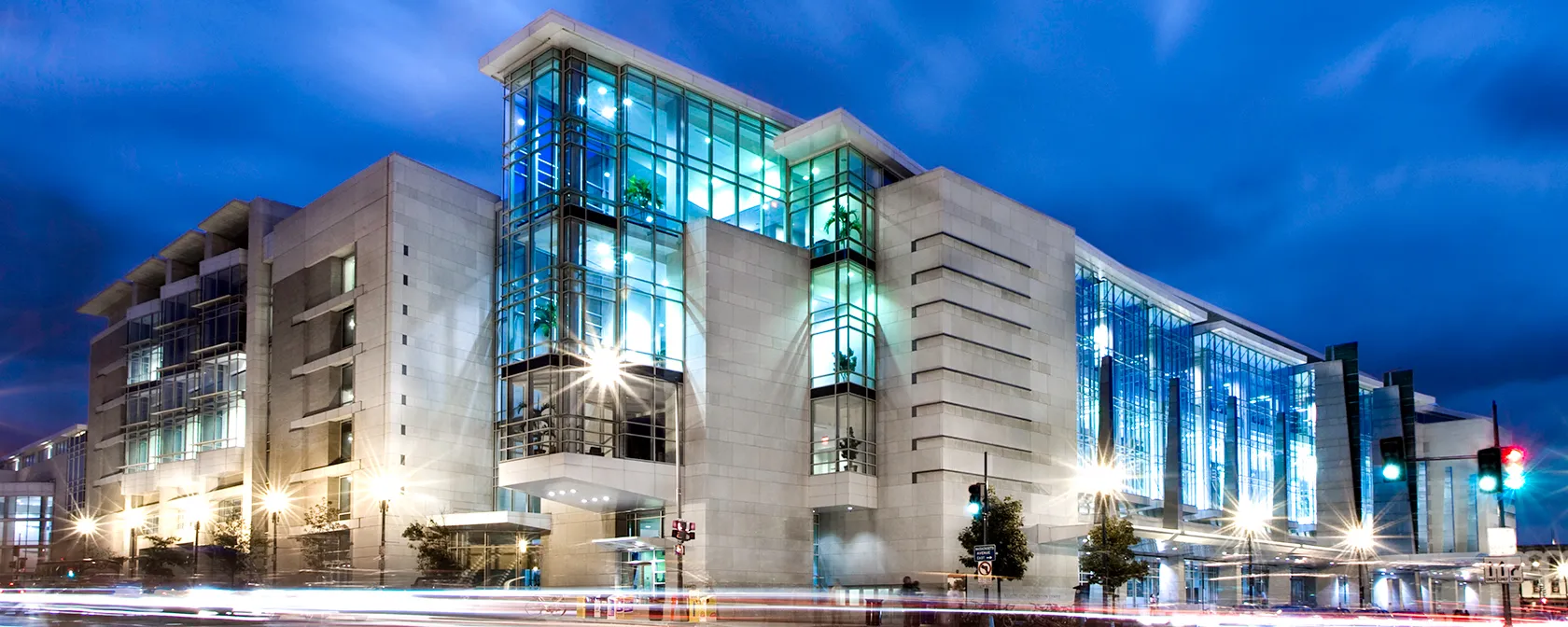
The Walter E. Washington Convention Center is the first convention center in the world to earn the WELL Health-Safety Rating (2022), the first in the Northeast United States to achieve the GBAC STAR accreditation, and one of only four convention centers in the U.S. to be awarded LEED Platinum certification. With a prime location in the heart of downtown, the world-class Walter E. Washington Convention Center is as functional as it is artistically impressive. The 2.3-million-sq.-foot space hosts meetings, conventions and events of every kind, from medical industry annual meetings to comic book-inspired expos and board retreats. See the space now with this virtual tour. Here’s why the Walter E. Washington Convention Center is meetings central in Washington, DC: Intimately Spacious You can mold all 703,000 sq. feet of exhibition space inside the convention center into whatever shape you need. Within its two levels and five exhibit halls is a 473,000-sq.-foot exhibit hall that can be subdivided into three rooms, 198,000 sq. feet of flexible meeting space, a 52,000-sq.-foot ballroom and 77 breakout rooms. The venue is versatile enough to accommodate events of all sizes. Art & Design Impressive. Striking. Modern. These are the words to describe the building, which has been recognized by the prestigious American Institute of Architects. The ultra-modern structure features a soaring staircase, towering glass walls and smooth granite floors. Its $6 million public art collection combines sculpture, paintings and photography. With more than 130 pieces by 93 different artists, it is the largest public collection of art in DC outside of a museum. The collection showcases living artists from the local community with approximately 50 percent from Washington, DC. Among the highlights: works by Sam Gilliam of the Washington Color School, a group of DC-area artists who developed a form of abstract art in the 1950s and 1960s. Sustainability The Walter E. Washington Convention Center has recently achieved LEED Platinum certification, a prestigious recognition of its commitment to environmental sustainability. It is now one of only four convention centers in the United States to hold this elite status, further cementing its leadership in green building practices. The building boasts a long list of energy-reducing features, from LED upgrades to all lighting systems to solar film-insulated windows and computerized HVAC systems as well as smart building designs and sustainability programs, including color-coded recycling protocol, water efficiency, and green product purchasing. Partnering with Aramark Environmental Service, the center is working towards the proper sorting of its recycling to ensure everything is processed correctly. “Behind the scenes, we have five massive docks all prepared to receive large volumes of sorted trash recycling,” Hootan Kaboli, senior vice president, Office of Executive for Events DC says. The Center further reduces its organic waste through a robust composting program. In partnership with PepsiCo, the center has also installed a “Dream Machines” set that encourages attendees to recycle their bottles and cans. All paper products provided by the center are ECOLOGO certified and made from 100 percent recycled fiber. Additionally, the center works with the local government to recycle over 50 palettes a month, many going to a furniture maker who transforms them into functional seating and platforms. Surplus food from events is redirected to the DC Central Kitchen and Capital Area Food Bank. Award-Winning Digital Signage The Walter E. Washington Convention Center is the largest digital signage network of its kind in any conference facility in the United States with over 200 digital signage displays located throughout the space. The convention center has significantly expanded its digital signage program adding 12 new LED video walls, a two-story curved video wall at the Concourse Rotunda, video walls above the exhibit halls and digital flags in front of the salons. Virtual reality, another new technology feature, uses 360-degree and 3D imagery allowing you to preview your experience inside the venue before booking. Complimentary WiFi access allows attendees to engage with real-time information. Ongoing Capital Improvements The past two years have kicked off a series of fresh renovations for the convention center. Upgrades include an interior redesign by architecture firm McKissack & McKissack, new furniture arrangements, unique lighting fixtures, Wi-Fi and USB ports, and an exterior streetscape renovation with new retail and greater live plants to bring nature indoors. A landscaped rooftop terrace remains in the plans. A new “Downtown Dining District” opened as part of a $16 million food and beverage investment. The former food court renovation included opening the more than 17,000-sq.-foot space up with direct entry from the Grand Lobby and views to the exhibit halls below. The space now seats 400 people and provides flexibility for various retail and catering functions, including a tasting room, restaurant, bar and induction kitchen. The Grand Lobby refresh initiative is geared towards optimizing the public spaces in the convention center by making them more flexible, user-friendly and tech-forward. Just outside, development in the historic Shaw neighborhood continues to bring new restaurants, breweries and retail to the convention and entertainment district. Local Cuisine & Retail For your event, Aramark is a premier catering option. The award-winning company serves more than 115 million guests annually, using fresh and local ingredients to fuel regional favorites and innovative international cuisine. Choose from popular catering packages to put together creative, custom-themed menus to perfectly complement your event. There are plenty of great places to eat and drink near the Walter E. Washington Convention Center. Guests seeking to taste the local flavor can drop by the convention center’s “Uptown Food District” where Ben’s Chili Bowl serves half-smokes, chili fries and more. Ben’s U Street flagship has been around since the late 1950s and is a hallmark in the District. Retail additions in the past year include Shop Made in DC, featuring packaged foods, clothing, arts and other gift items from over 50 DC makers. The exterior space surrounding the convention center also offers a wide range of retail and dining options, including new fine dining at Petite Cerise or sipping at Top Chef alum Spike Mendelsohn and cocktail connoisseur David Strauss' Morris American Bar, one of the city's most happy, brightly lit drinking establishments. For locally sourced snacks and on-the-go items, guests should check out Pearl’s Bagel, Union Kitchen Grocery, or they can grab a table at the Unconventional Diner, a high-end diner concept specializing in modern comfort food. Convention-goers can get their CrossFit fix at the Urban Athletic Club, which includes 3,000 sq. feet of training space, one-on-one training sessions and open gym hours. Guests in need of haircuts have it made at Cuttin-Up Barber Shop, which accepts walk-ins. The center is Metro accessible (Green/Yellow lines) with a dedicated Mt. Vernon-7th St-Convention Center stop and immediately walkable to Shaw's booming dining scene, downtown museums and nightlife, and the National Mall. Convention Center Floor Plans View floor plans overview in a higher resolution. Events DC owns and operates the Walter E. Washington Convention Center. To learn more, visit eventsdc.com.