

All Articles
SPONSORED
Visiting the Dwight D. Eisenhower Memorial
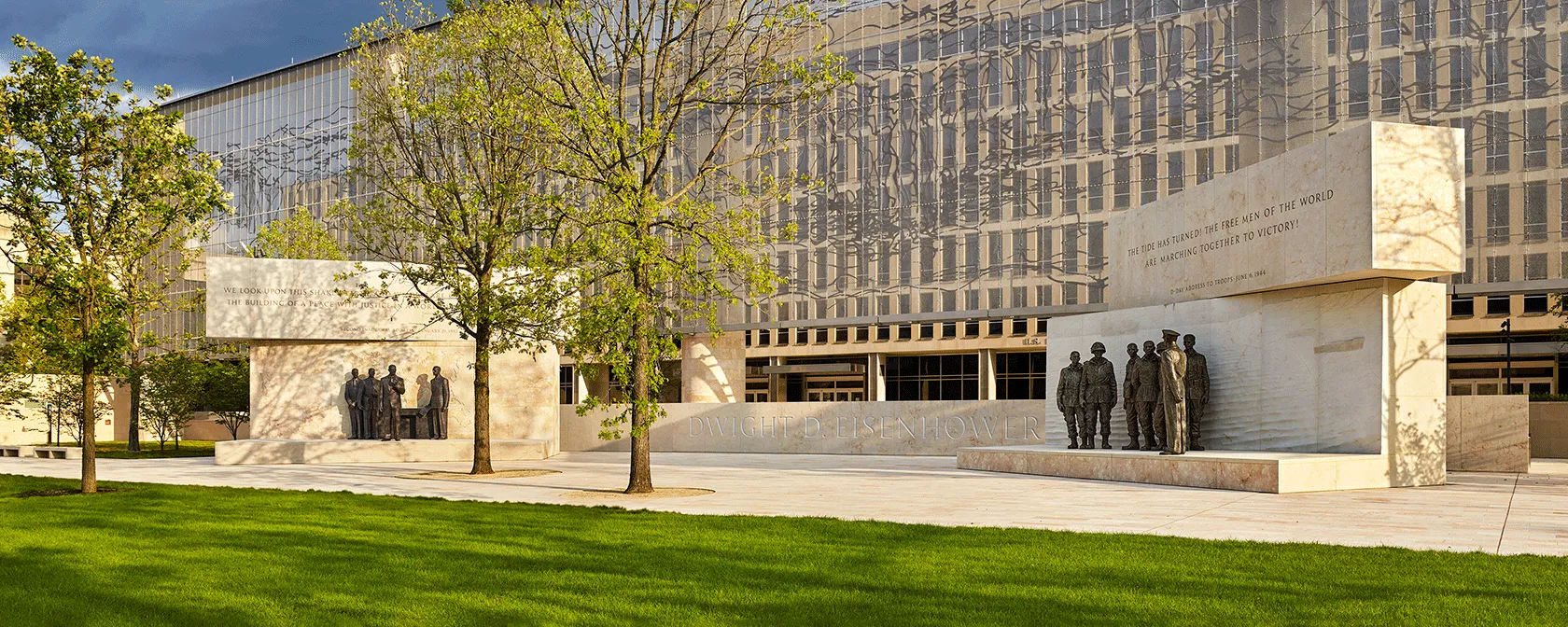
What is the Dwight D. Eisenhower Memorial and where is it? The Dwight D. Eisenhower Memorial, designed by world-renowned architect Frank Gehry, is located at the base of Capitol Hill at 540 Independence Avenue SW. The four-acre urban park features a variety of pieces that symbolize Eisenhower’s inspirational feats during his time as the supreme commander of the Allied Expeditionary Force in Europe during World War II and as the 34th U.S. president. View this post on Instagram A post shared by Mary Laurin (@fiddlefun2) What will I see at the Dwight D. Eisenhower Memorial? The memorial site itself holds a close and unique relationship to Eisenhower’s life-long commitment to public service. The federal entities neighboring the Maryland Avenue site demonstrate Eisenhower’s broad legacy of improved national infrastructure, the foundation upon which he worked to build “a peace with justice in a world where moral law prevails.” In honor of his military accomplishments, General Eisenhower appears with paratroopers of the 101st Airborne Division before the Battle of Normandy. Behind the sculptures is a bas relief featuring Eisenhower that depicts the Normandy landings on D-Day, June 6, 1944. His time as president is memorialized through sculptures that symbolize the balance of security and liberty that Eisenhower worked to achieve. One features Dwight in the Oval Office surrounded by military and civilian advisors. A map of the world in bas relief stands behind, reflecting Eisenhower’s internationalism and role as a world leader. A life-size sculpture of young Eisenhower takes you to the beginning of his journey. The piece is accompanied by an inscription of an excerpt from Eisenhower's Abilene Homecoming Speech in Kansas on June 22, 1945, where he declared “the proudest thing I can claim is that I am from Abilene.” A stainless-steel tapestry frames the entire memorial and portrays an abstract depiction of the Normandy coastline in peacetime to represent the peace Eisenhower won as supreme commander, then preserved as commander-in-chief. The iconic Pointe du Hoc landmark is featured at the center of the hand-drawn image. The one-of-a-kind piece is 450 feet long, supported by 80-foot stone-clad columns, and the image will appear differently throughout the day based on light and shadows. Free audio guides are available for your self-guided tour.

Everything You Need to Know About Washington Monument Tours & Tickets
If you’re looking to get tickets to the top or learn more, read below for some helpful tips for both groups and individuals to keep in mind when visiting the iconic monument built to honor George Washington, the commander-in-chief of the Continental Army and the first president of the United States. Where can I reserve tickets in advance? Advance reservation tickets can be reserved online through recreation.gov up to 30 days in advance (up to six tickets per transaction). While visiting the Washington Monument is free, a convenience fee of $1 USD will be charged for each ticket. This fee is non-refundable. There are also a limited number of tickets made available at 10 a.m. each day for the next day's visits (for example: On May 7 at 10 a.m., tickets will become available for visits on May 8). How do I acquire next-day tickets to the Washington Monument? Inventory for the next available day becomes available at 10 a.m. each morning. During peak season (March-August, late December-early January), demand for tickets is very high. Advance tickets may sell out within seconds. How do I acquire same-day tickets for the Washington Monument? Day-of walk-up tickets are distributed each morning at 8:45 a.m. at the Washington Monument Lodge, located on Madison Drive on the east side of the monument grounds. During peak season (March-August, late December-early January), demand for tickets is very high and the line begins forming as early as 7 a.m. Walk-up tickets are not available for groups. What are the ticketed time slots and how many tickets are available per time slot? The Washington Monument is open 9 a.m. to 5 p.m. daily except for Dec. 25, July 4 and part of July 3 and one day per month for scheduled maintenance. Tickets are scheduled every half hour from 9 a.m. to 4 p.m. How will the tickets be delivered? Visitors can access purchased tickets via confirmation email. All visitors must print their tickets in advance or have their tickets available to view on a mobile device. Please ensure you have these tickets ready to present prior to your arrival at the Washington Monument. Can tickets be returned? Yes, tickets can be cancelled until 2 p.m. the day prior to the tour. The convenience fee for purchase is non-refundable. In the case that the Monument must close, tickets will not be exchanged or refunded. What time should visitors arrive before their ticketed time? Visitors must arrive by the time on their ticket. If late, National Park Service staff has discretion to limit/deny monument entry. What is security like at the Washington Monument? Recent Washington Monument renovations have led to adjustments in security procedures. Please keep in mind: It is best to bring as little to the Washington Monument as possible. Water is only allowed in clear plastic bottles. Individuals do need to pass through a security area similar to an airport. Park Rangers will direct you to the security screening area in small groups. All visitors are subject to security screening. Weapons, strollers and bulky items are prohibited. Wheelchairs are permitted. Check online for a full list of restricted items. What is the tour flow after security? Visitors will be directed to the Washington Monument's ground floor lobby. Approximately 15 people will be allowed onto the elevator from the hallway by a National Park Service Ranger. The express ascent to the top floor (500 feet above the ground) lasts approximately 70 seconds. Groups may remain on the Observation Level for as long as they like. At the end of the visit, a park ranger will help you board the elevator for the descent, during which some of the commemorative stones on the monument’s interior walls will be visible. Is there still a stairway tour? No, stairway tours are no longer available. Will the Washington Monument have extended hours during the busy season? Not at the moment. During peak season (March-July), demand for tickets is very high. Advance tickets may sell out within minutes. Continue discovering the history of our nation's capital by exploring DC's other monuments and memorials.
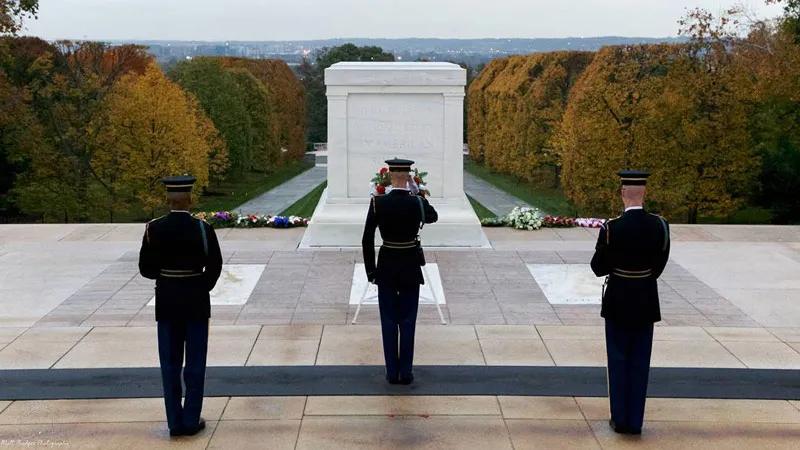
Guide to Visiting Arlington National Cemetery
What is Arlington National Cemetery? The Arlington National Cemetery is the country’s largest military cemetery and serves as the final resting place for more than 400,000 military veterans and their immediate family from the fronts of Iraq and Afghanistan, as well as World Wars I and II, the Korean conflict, Vietnam, the Cold War and America’s Civil War. The cemetery conducts between 27 and 30 funerals every weekday. The site is open to the public 365 days a year with free admission for those who wish to tour the site and pay their respects. Important sites at Arlington National Cemetery Arlington National Cemetery is the home of several well-known historic sites, including the Tomb of the Unknown Soldier, which is a tribute to unidentified fallen soldiers who fought in World War I, World War II, Korea and Vietnam. The Tomb of the Unknown Soldier is a large white sarcophagus that is guarded 24 hours a day, 365 days a year by Tomb Guard sentinels from the elite 3rd U.S. Infantry Regiment. The Changing of the Guard ritual—an elaborate, somber ceremony where a sentinel seamlessly takes over guard duty for the previous sentinel—happens every hour from October through March and every half hour from April through September. The gravesite of President John F. Kennedy is also on view at Arlington National Cemetery. At his funeral on Nov. 25, 1963, Jacqueline and Robert Kennedy lit an eternal flame that remains alight today. Two of Kennedy’s children and Jacqueline Bouvier Kennedy Onassis are also buried alongside the president. In addition to the Kennedy family, President William Howard Taft, Senator Robert F. Kennedy, Supreme Court Justice Thurgood Marshall, world champion boxer Joe Louis, the seven Space Shuttle Challenger astronauts and the Tuskegee Airmen are also buried at Arlington National Cemetery. Arlington House, the former residence of Robert E. Lee, sits on a hill overlooking the cemetery. Originally built to be a living memorial to George Washington, in 1864 the grounds were taken over by the federal government to serve as a burial site for Civil War soldiers. Over the years, the house was also used as a plantation estate and home to 63 slaves, a military headquarters, a community for emancipated slaves and a national cemetery. The preserved historic home is open for public tours daily. On Memorial Day and Veterans Day, thousands of visitors attend remembrance services in the Memorial Amphitheater. These special services are often attended by the President or Vice President of the United States. Getting to and touring Arlington National Cemetery The easiest way to get to Arlington National Cemetery is by Metro via the direct Arlington Cemetery stop on the Blue Line. Metrobus routes also stop at the site and it is accessible by several major roadways, including the George Washington Parkway. Once you’ve arrived, start at the Welcome Center, which offers an overview of the site. Here you can also sign up for a bus tour that stops at various sites throughout the cemetery. The cemetery is built into a hill and requires extensive walking if you choose to skip the shuttle.

Guide to Visiting the Washington Monument
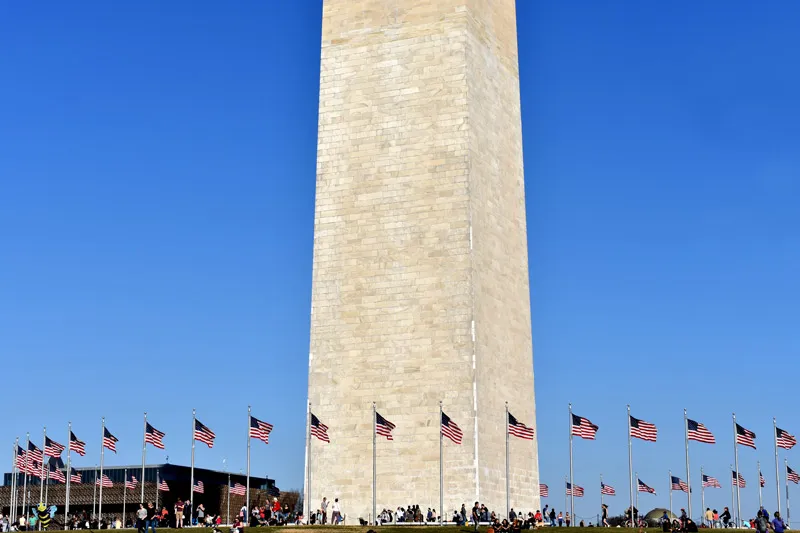
Built to honor George Washington, the Continental Army's commander-in-chief and the first United States president, the Washington Monument was once the tallest building in the world at just over 555 feet. The monument to America’s first president still holds the title of the world’s tallest stone structure and obelisk. The New & Improved Washington Monument After years of renovations and reopening in 2019, the Washington Monument has raised expectations for visitors with a new state-of-the-art elevator that will efficiently move hundreds of visitors up to the observation deck daily. The minute-long ride up 50 stories to the top of the world's tallest free-standing stone structure includes a video from the National Park Service about what to expect. From the observation deck, you can see nearly 25 miles into the horizon in every direction, including landmarks like the U.S. Capitol, the White House, Arlington National Cemetery and the Washington National Cathedral. Part of what makes traveling in the elevator so historic is that, on the two-minute descent, it offers a glimpse of the interior walls, which are lined with stones that commemorate George Washington, placed by states, civic groups and others. The modern system gives the National Park Service operators better control of the elevator with remote access from the ground. Before experiencing the new elevator, visitors will encounter another improvement to traveling to the top of the Washington Monument – an upgraded security screening facility at the base of the structure. The new security structure can accommodate up to 20 visitors and has more modern screening equipment. The Washington Monument is open 9 a.m. to 5 p.m. daily (last available tour ticket is at 4 p.m.) except for December 25, July 4 and part of July 3. Visitors can reserve tickets on recreation.gov in advance. A limited number of walk-up tickets are available on a first-come, first-serve basis beginning at 8:45 a.m. outside of the Washington Monument Lodge. Find out more information with our Washington Monument tour and ticket guide for both groups and individuals. More on the Washington Monument Maintained by the National Park Service, the Washington Monument is located on the center of the National Mall between the U.S. Capitol and the Lincoln Memorial. The easiest way to get to the monument is by taking the Metro. The two closest Metro stops are Federal Triangle and Smithsonian, both on the Blue, Orange and Silver lines. If traveling by bus, take DC Circulator’s National Mall route or ride Metrobus routes 32, 34, or 36. If driving, visitor parking is available on Ohio Drive, between the Lincoln and Jefferson memorials. Note that street parking is often limited near the National Mall. Why does the Washington Monument have two colors? It wasn't easy to build Washington Monument. The structure was originally designed by Robert Mills, with construction beginning in 1848. The combination of the Civil War, the Know Nothing Party's rise to control of the Washington National Monument Society through an illegal election and lack of funding led to a halt in construction in 1854. When construction resumed in 1879, marble was used from a different quarry, and time and weather erosion led to the difference in color, which begins at the 150-foot mark. The monument was finally completed in 1884 by Thomas Casey and the U.S. Army Corps of Engineers and an elevator was added to the monument in 1889.