
All Articles
SPONSORED
Visiting the Dwight D. Eisenhower Memorial
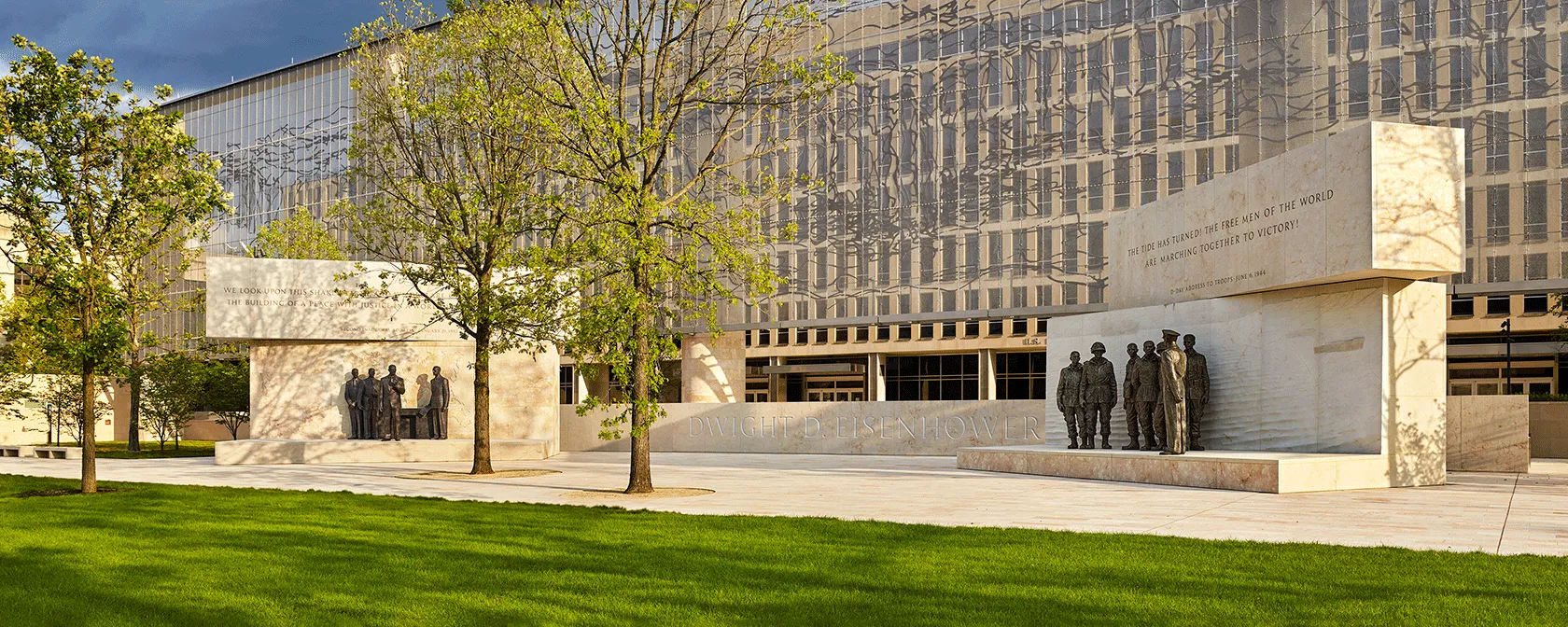
What is the Dwight D. Eisenhower Memorial and where is it? The Dwight D. Eisenhower Memorial, designed by world-renowned architect Frank Gehry, is located at the base of Capitol Hill at 540 Independence Avenue SW. The four-acre urban park features a variety of pieces that symbolize Eisenhower’s inspirational feats during his time as the supreme commander of the Allied Expeditionary Force in Europe during World War II and as the 34th U.S. president. View this post on Instagram A post shared by Mary Laurin (@fiddlefun2) What will I see at the Dwight D. Eisenhower Memorial? The memorial site itself holds a close and unique relationship to Eisenhower’s life-long commitment to public service. The federal entities neighboring the Maryland Avenue site demonstrate Eisenhower’s broad legacy of improved national infrastructure, the foundation upon which he worked to build “a peace with justice in a world where moral law prevails.” In honor of his military accomplishments, General Eisenhower appears with paratroopers of the 101st Airborne Division before the Battle of Normandy. Behind the sculptures is a bas relief featuring Eisenhower that depicts the Normandy landings on D-Day, June 6, 1944. His time as president is memorialized through sculptures that symbolize the balance of security and liberty that Eisenhower worked to achieve. One features Dwight in the Oval Office surrounded by military and civilian advisors. A map of the world in bas relief stands behind, reflecting Eisenhower’s internationalism and role as a world leader. A life-size sculpture of young Eisenhower takes you to the beginning of his journey. The piece is accompanied by an inscription of an excerpt from Eisenhower's Abilene Homecoming Speech in Kansas on June 22, 1945, where he declared “the proudest thing I can claim is that I am from Abilene.” A stainless-steel tapestry frames the entire memorial and portrays an abstract depiction of the Normandy coastline in peacetime to represent the peace Eisenhower won as supreme commander, then preserved as commander-in-chief. The iconic Pointe du Hoc landmark is featured at the center of the hand-drawn image. The one-of-a-kind piece is 450 feet long, supported by 80-foot stone-clad columns, and the image will appear differently throughout the day based on light and shadows. Free audio guides are available for your self-guided tour.
Visiting the Jefferson Memorial in Washington, DC
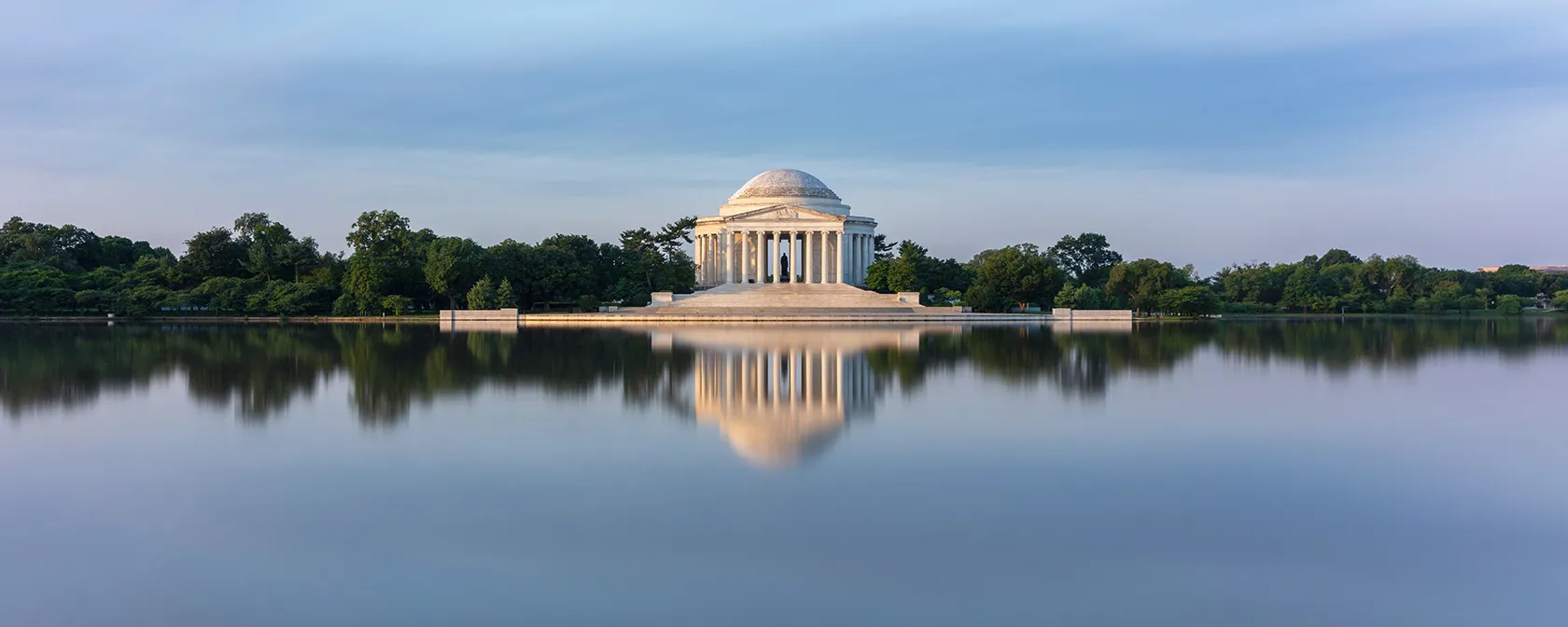
Where and what is the Jefferson Memorial? The location and architecture of the Thomas Jefferson Memorial make it stand out among DC’s amazing array of monuments and memorials. Designed by John Russell Pope in 1925, the memorial resembles the Pantheon in Rome, an adaptation of Neoclassical architecture favored by Thomas Jefferson himself. Surrounded by water, the structure is located on the National Mall's Tidal Basin, a large body of water that is bordered by DC’s famous cherry blossom trees. On a moonlit night, the memorial creates a beautiful, shimmering image on the water, and in springtime, it’s joined by blooming cherry blossom trees. What will I see at the Jefferson Memorial? As philosopher and statesman, Thomas Jefferson served in many capacities during his life: lawyer, politician, scientist, linguist, meteorologist, book collector, architect, farmer and diplomat. Of course, his two most famous posts were as the third U.S. president and the author of the first draft of the Declaration of Independence. The memorial is meant to reflect his diverse and plentiful accomplishments. The open-air, white columned structure shelters a 19-foot bronze statue of Jefferson, standing at the ready to welcome visitors. His gaze is toward the White House; the artist, Rudolph Evans, wanted the statue to represent the Age of Enlightenment, an 18th century European intellectual movement that stressed liberty and equality as natural human rights. Jefferson and his revolutionary generation fervently believed in this idea. However, Jefferson’s legacy is complicated by the fact that he was also a slave owner. The walls of the Jefferson Memorial contain words from his various texts; one expresses his idea about the right to religious freedom, while another features the importance of changing laws to represent the changing times. One of the memorial’s most powerful sights can be found on its southwest wall. On the left side of the Jefferson statue, you will find some of the most impactful words in the history of the United States, taken directly from the Declaration of Independence: "We hold these truths to be self-evident: that all men are created equal, that they are endowed by their Creator with certain inalienable rights, among these are life, liberty, and the pursuit of happiness." Jefferson Memorial hours and directions The Jefferson Memorial is open 24 hours a day, every day of the year. Rangers are on duty from 9:30 a.m. to 10 p.m. daily. The most convenient way to reach the memorial is by Metrorail or Metrobus. The closest Metro station is Smithsonian, located on the Orange, Blue and Silver lines. As for the bus, take either the 32, 34 or 36 routes.
Visiting the Korean War Veterans Memorial in Washington, DC
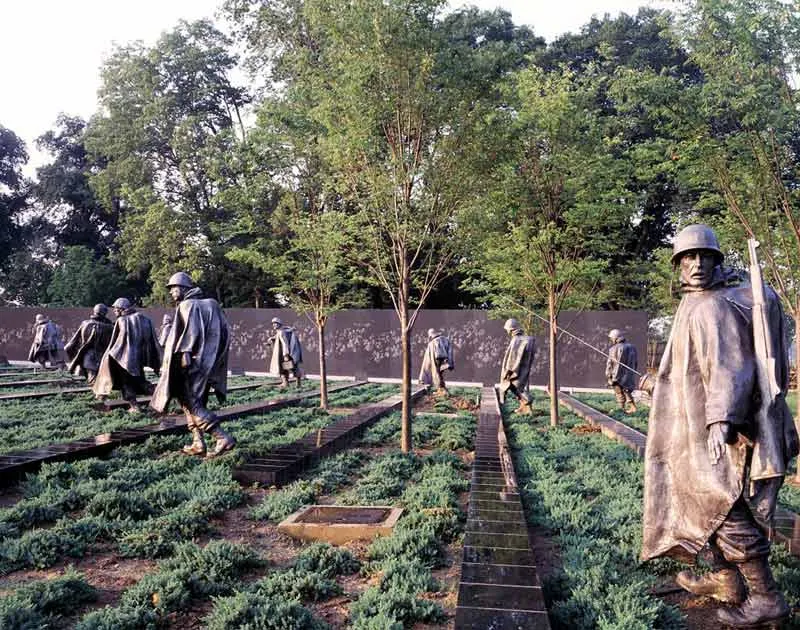
What is the Korean War Veterans Memorial and where is it? The Korean War Veterans Memorial resides on the National Mall, southeast of the Lincoln Memorial and just south of the Reflecting Pool. All of its components, including its walls, stainless steel statues and Pool of Remembrance, are dedicated to members of the U.S. Armed Forces that served and sacrificed during the Korean War. The memorial is free and open to the public 24 hours a day, with rangers on duty to answer questions from 9:30 a.m. to 10 p.m. daily. Interpretive programs are provided throughout the day and upon request. The most convenient way to reach the Korean War Veterans Memorial is public transportation. The DC Circulator’s National Mall route and Metrobus routes 32, 34 and 36 service the area. The closest Metro stations are Smithsonian and Federal Triangle, on the Orange, Blue and Silver lines (Foggy Bottom is also an option). What will I see at the Korean War Veterans Memorial? The Korean War Veterans Memorial consists of multiple structures that honor those who sacrificed during the three-year conflict (1950-1953) that was the Korean War. The memorial’s mural wall measures 164 feet long and eight inches thick, and from a bird’s eye view, the wall appears as an isosceles triangle, with the tip intersecting a circle over the Pool of Remembrance. Images of troops moving by sea, land and air are sandblasted onto the surface of the wall, while a squadron of 19 stainless steel figures, including members from each branch of the U.S. Armed Forces, are situated in the center of the memorial space. When the 1,000-pound statues are reflected on the granite wall, there appears to be 38 soldiers, which represents the 38th parallel, the dividing line of North and South Korea during the conflict. The Korean War Veterans Memorial also features a United Nations wall, which lists all 22 members of the U.N. that contributed to the war efforts, as well as a granite wall that states “Freedom Is Not Free.” This sentiment reflects the struggle and sacrifice of American soldiers in securing our freedoms when fighting overseas. A visit to the memorial is not complete without a look at the Pool of Remembrance, which has inscriptions that list the number of soldiers killed, wounded, missing in action and held as prisoners during the Korean War. The shallow pool, which is 30 feet in diameter, is surrounded by trees positioned so that the sun beautifully reflects off of the water. Honor a veteran On any given visit, you may encounter former servicemen at the memorial. In fact, the Honor Flight Network is a non-profit dedicated to bringing vets, often elderly, to DC to visit the memorials which honor their service to the nation. These visits are often filled with emotions and help provide closure for veterans by reinforcing the importance of their service and sacrifice.
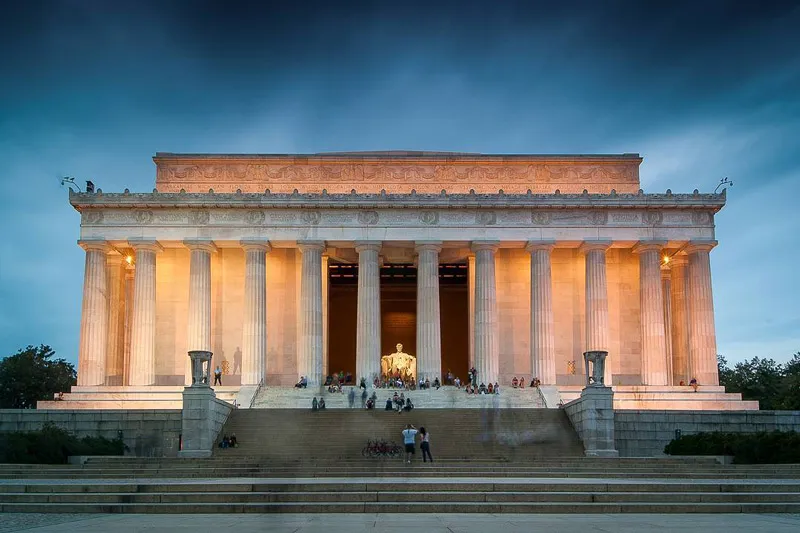
Visiting the Lincoln Memorial in Washington, DC
Experiencing the Lincoln Memorial The grand Lincoln Memorial towers over the Reflecting Pool, anchoring the western end of the National Mall. The best way to approach the memorial is from the east, by the Washington Monument and the National World War II Memorial. This will put you at the edge of the Reflecting Pool, a shimmering expanse which best illuminates the grand structures honoring our most storied leaders. Take a stroll toward the memorial and watch as it gradually gets larger. When you stand directly in front, gaze at the handsome marble columns surrounded by greenery, part of a design inspired by ancient Greek temples. There are 36 columns, each one representing one state in the U.S. at the date of President Lincoln’s death. The memorial itself is 190 feet long and 119 feet wide, and reaches a height of almost 100 feet. Climb the stairs leading to the interior, and look up. There, etched into the wall, is a memorable quote: "In this temple, as in the hearts of the people for whom he saved the Union, the memory of Abraham Lincoln is enshrined forever." Below the quote sits a 19-foot tall, 175-ton statue of President Lincoln, himself looking out over the Mall of the country that he fought so hard to preserve and unite. The statue was designed by Daniel Chester French, who worked to depict Lincoln during the Civil War, stately and dignified. Interestingly, though the memorial was approved decades earlier, construction did not begin until 1914, and the memorial opened to the public in 1922. To the left of the statue is Lincoln’s great speech, the Gettysburg Address, one of the most famous in U.S. history. Every single word of the address is etched into the wall to inspire Americans just as it did in 1863. To the right is the entire Second Inaugural Address, given in March of 1865 — mere months before Lincoln’s death. Lincoln Memorial hours and directions The Lincoln Memorial is open 24 hours a day, every day of the year. Rangers are on duty from 9:30 a.m. to 10 p.m. daily. The easiest way to reach the Memorial is by Metrorail or Metrobus. The nearest Metro stations are Foggy Bottom and Smithsonian, both on the Orange, Blue and Silver lines. If traveling by Metrobus, take the 32, 34 or 36 routes. Capital Bikeshare also has a dock nearby, on Daniel French Drive SW.
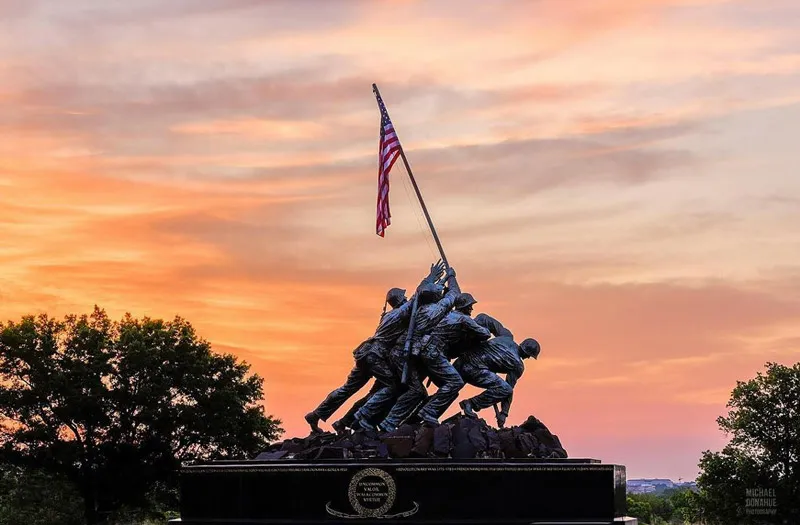
Visiting the Marine Corps War Memorial
The U.S. Marine Corps War Memorial's world-famous statue, which is based on the iconic photograph taken by Associated Press photographer Joe Rosenthal, depicts the six Marines who raised of the second American flag at Iwo Jima in the Japanese Volcano Islands on February 23, 1945, signifying the conclusion of the American campaign in the Pacific during World War II. The memorial is dedicated to “the Marine dead of all wars and their comrades of other services who fell fighting beside them.” The memorial was dedicated on November 10, 1954 by President Dwight D. Eisenhower and the American flag has flown from the statue 24 hours a day, 365 days a year by presidential proclamation ever since. The bronze statue was made by sculptor Felix W. de Weldon. He worked with the three surviving Marines from the battle, Rene A. Gagnon, Ira Hayes and John H. Bradley, to model their faces in clay. The base of the memorial is engraved with every major battle involving the U.S. Marine Corps since 1775. Getting to the Marine Corps War Memorial The Iwo Jima Memorial is located outside of Arlington National Cemetery in Arlington Ridge Park in Virginia, just across the Potomac River from Washington, DC. The memorial can be accessed by car via the VA-110 South route or US-50 East or West routes. Parking is available at the memorial. If you take Metro, get off at either the Rosslyn station (Orange, Silver or Blue lines) or Arlington National Cemetery station (Blue Line). It is a 10-15 minute walk from either of these stations. What to do at the Marine Corps Memorial The grounds of the Marine Corps War Memorial are open from 6 a.m. until midnight, year-round. National Park Ranger-led programs can be requested in advance by calling 703-235-1530. During the summer on Tuesday evenings, the U.S. Marine Corps band performs free hour-long drum and bugle concerts called Sunset Parades. During the Sunset Parades, parking is not permitted on the memorial grounds, but visitors may park at Arlington National Cemetery Visitors Center and take a shuttle to the grounds. The view from the Iwo Jima Memorial is also one of the best spots to snap a photo of the iconic panorama of the Lincoln Memorial, Washington Monument and U.S. Capitol.
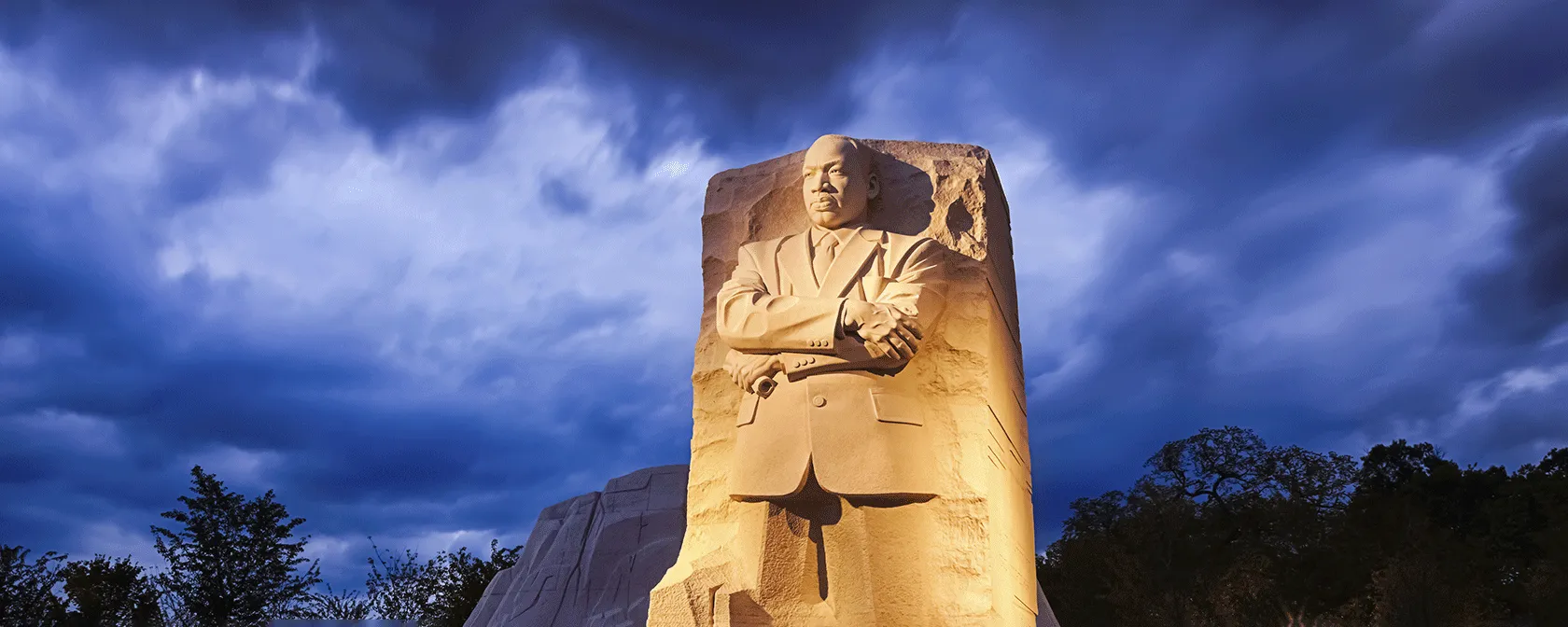
Visiting the Martin Luther King, Jr. Memorial in Washington, DC
Experience the Martin Luther King, Jr. Memorial in 360-degree video On your Phone? Open the 360-degree video in the YouTube app for the best viewing experience. What is the Martin Luther King, Jr. Memorial and where is it? The Martin Luther King, Jr. Memorial is situated on a four-acre site along the National Mall's Tidal Basin, adjacent to the Franklin D. Roosevelt Memorial and shares a direct line of sight between the Lincoln and Jefferson memorials. Its official address is 1964 Independence Avenue SW, in honor of the Civil Rights Act of 1964, a landmark legislation in which King played an important role. Dr. Martin Luther King, Jr. was one of the most prominent leaders of the Civil Rights Movement in the 1960s, becoming an iconic figure through his incredible speeches and his use of nonviolent resistance. He led the famous March on Washington in 1963, where he gave his legendary “I Have a Dream” speech on the steps of the Lincoln Memorial. Opened to the public in 2011, the memorial is the fourth in Washington, DC to honor a non-president and the first to honor a man of color. The site was designed as a lasting tribute to Dr. King’s legacy and will forever serve as a monument to the freedom, opportunity and justice for which he stood. Martin Luther King, Jr. Memorial hours and directions The most convenient way to reach the Martin Luther King, Jr. Memorial is by Metrobus or Metro. The closest Metro stop is Smithsonian, on the Orange, Blue and Silver lines. Of course, the memorial is in very close proximity to the other memorials surrounding the Tidal Basin. The Martin Luther King, Jr. Memorial is open 24 hours a day, seven days a week. There is no fee to visit. National Park Service rangers are on site to answer questions from 9:30 a.m. to 10 p.m. daily. Interpretive programs are available throughout the day and upon request. Please make sure to wear a facial covering and maintain a safe social distance when visiting the memorial. What will I see at the Martin Luther King, Jr. Memorial? The centerpiece of the memorial is a 30-foot statue of Dr. King, featuring his likeness carved into the Stone of Hope, which emerges powerfully from two large boulders, known as the Mountain of Despair. Together, they represent soul-stirring words from Dr. King’s “I Have a Dream” speech. Text from this speech is cut sharply into the rock of the Stone: “Out of the mountain of despair, a stone of hope.” Visitors enter through the Mountain of Despair and tour the memorial as if moving through the struggles that Dr. King faced during his life. Visitors end in the open freedom of the plaza. The solitary Stone of Hope stands proudly, depicting the civil rights leader gazing over the Tidal Basin towards the horizon, forever encouraging all citizens to strive for justice and equality. Surrounding the statue of Dr. King is a 450-foot long Inscription Wall, which features 14 quotes from King’s speeches, sermons and writings. Inscriptions were chosen by a special “Council of Historians,” which included Maya Angelou and Henry Louis Gates. Quotes were chosen with Dr. King’s four main principles in mind: justice, democracy, hope and love.
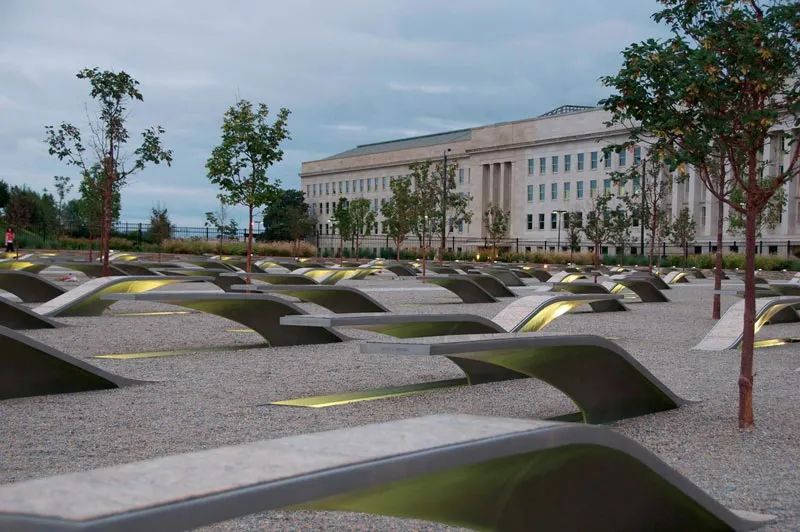
Visiting the National 9/11 Pentagon Memorial
Where and what is the National 9/11 Pentagon Memorial? The National 9/11 Pentagon Memorial is a national memorial dedicated to the tragic events that occurred on Sept. 11, 2001. All 184 lives lost in the attack on the Pentagon are represented by “Memorial Unit” benches. Surrounding the benches are 85 Crape Myrtles (trees that will grow up to 30 feet tall) and the Age Wall, which grows one inch in height per year relative to the ages of the victims. The memorial is located just outside the Pentagon, which has limited parking, meaning the best way to reach the site is to take the Metrorail to the Pentagon or Pentagon City stops on the Blue and Yellow lines and walk from there. The memorial is free and is usually open to the public 24 hours a day, 365 days a year. The public restrooms by the entrance are open from 7 a.m. – 10 p.m. What will I see at the National 9/11 Pentagon Memorial? The Pentagon Memorial has an emotive power that few other memorials have, due to both the recency of the tragedy it pays homage to and its comprehensive listing of victims. When first approaching the expansive Memorial Gateway, visitors will spot a black granite stone stating the date and time of the tragic plane crash: Sept. 11, 2001 at 9:47 a.m. Words describe its purpose: “We claim this ground in remembrance of the events of September 11, 2001, to honor the 184 people whose lives were lost, their families, and all who sacrifice that we may live in freedom. We will never forget.” Each of the aforementioned Memorial Units (or benches) has a victim’s age and location at the time of the attack inscribed on it. The benches are arranged along an age line, according to the year each victim was born. They are positioned to differentiate those who were on board American Airlines Flight 77 and those who were in the Pentagon, and each contains a pool of water that reflects light in the evenings. The units honoring victims on board Flight 77 face the direction of the plane’s approach to the Pentagon, while those reading the names of Pentagon victims face the plane’s point of impact on the Pentagon’s south facade. To learn more about the National 9/11 Pentagon Memorial, visit the memorial's website.