
All Articles
SPONSORED
Visiting the Dwight D. Eisenhower Memorial
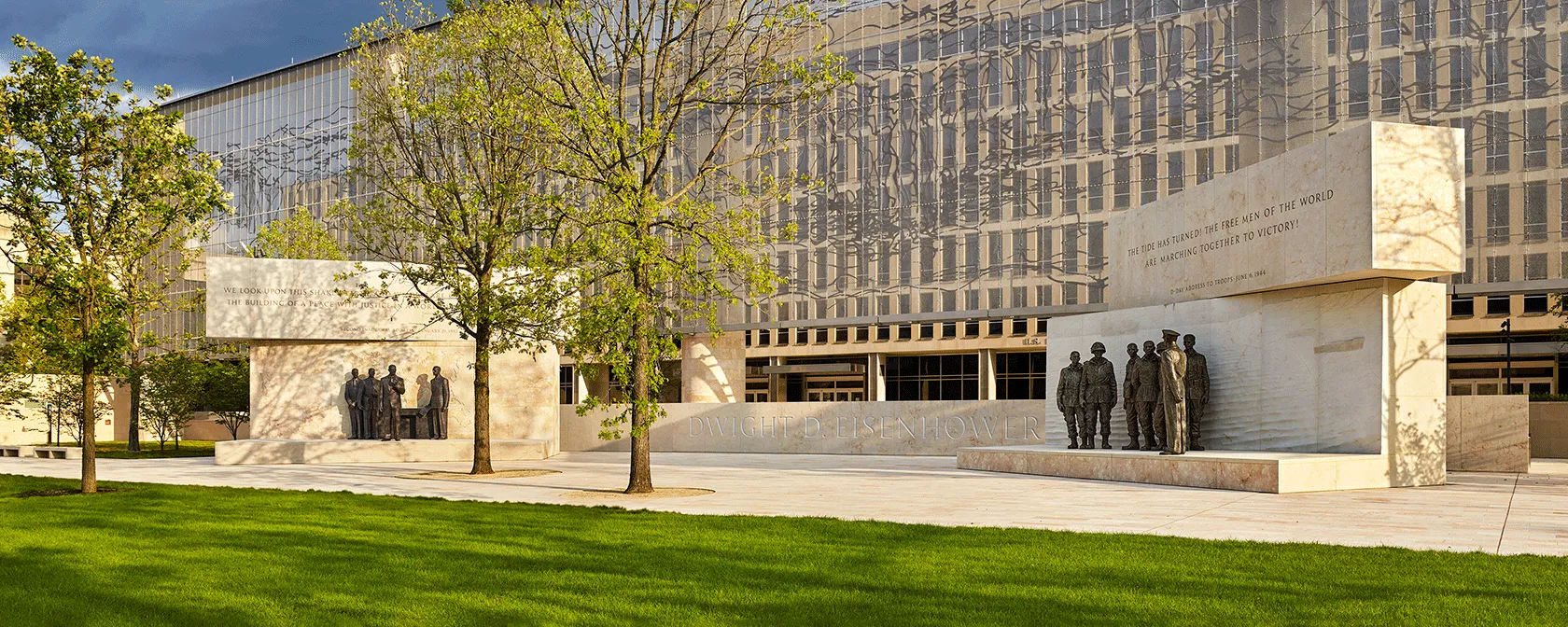
What is the Dwight D. Eisenhower Memorial and where is it? The Dwight D. Eisenhower Memorial, designed by world-renowned architect Frank Gehry, is located at the base of Capitol Hill at 540 Independence Avenue SW. The four-acre urban park features a variety of pieces that symbolize Eisenhower’s inspirational feats during his time as the supreme commander of the Allied Expeditionary Force in Europe during World War II and as the 34th U.S. president. View this post on Instagram A post shared by Mary Laurin (@fiddlefun2) What will I see at the Dwight D. Eisenhower Memorial? The memorial site itself holds a close and unique relationship to Eisenhower’s life-long commitment to public service. The federal entities neighboring the Maryland Avenue site demonstrate Eisenhower’s broad legacy of improved national infrastructure, the foundation upon which he worked to build “a peace with justice in a world where moral law prevails.” In honor of his military accomplishments, General Eisenhower appears with paratroopers of the 101st Airborne Division before the Battle of Normandy. Behind the sculptures is a bas relief featuring Eisenhower that depicts the Normandy landings on D-Day, June 6, 1944. His time as president is memorialized through sculptures that symbolize the balance of security and liberty that Eisenhower worked to achieve. One features Dwight in the Oval Office surrounded by military and civilian advisors. A map of the world in bas relief stands behind, reflecting Eisenhower’s internationalism and role as a world leader. A life-size sculpture of young Eisenhower takes you to the beginning of his journey. The piece is accompanied by an inscription of an excerpt from Eisenhower's Abilene Homecoming Speech in Kansas on June 22, 1945, where he declared “the proudest thing I can claim is that I am from Abilene.” A stainless-steel tapestry frames the entire memorial and portrays an abstract depiction of the Normandy coastline in peacetime to represent the peace Eisenhower won as supreme commander, then preserved as commander-in-chief. The iconic Pointe du Hoc landmark is featured at the center of the hand-drawn image. The one-of-a-kind piece is 450 feet long, supported by 80-foot stone-clad columns, and the image will appear differently throughout the day based on light and shadows. Free audio guides are available for your self-guided tour.
Visiting the National World War II Memorial in Washington, DC
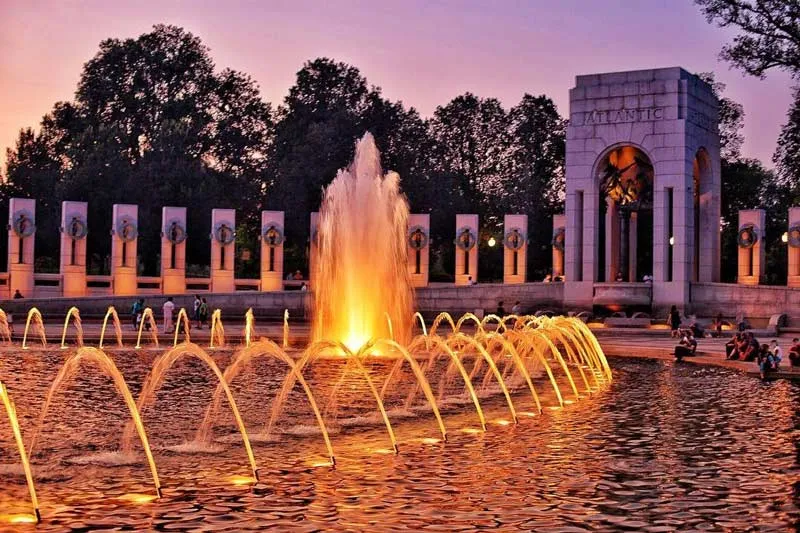
What is the National World War II Memorial and where is it? The National World War II Memorial honors the 16 million people who served as part of the U.S. Armed Forces during World War II, including more than 400,000 who gave the ultimate sacrifice for their country. The memorial sits along the central vista of the National Mall, at the east end of the Lincoln Memorial Reflecting Pool. The World War II Memorial is free and open to the public 24 hours a day. Park rangers are on duty to answer questions from 9:30 a.m. to 10 p.m. daily, and interpretive programs are provided throughout the day and upon request. The most convenient way to reach the memorial, often referred to as the WWII Memorial, is by Metrobus or Metro. There are two Metro stations close by: Smithsonian and Federal Triangle, both located on the Orange, Blue and Silver lines. As for the bus,take either the 32, 34 or 36 Metrobus routes. What will I see at the National World War II Memorial? Symbols of America’s triumph in the Second World War are artfully displayed all over the World War II Memorial, which has a splendid fountain at its center. 56 granite columns symbolize unity among the 48 states, seven federal territories and the District of Columbia. The columns form a semi-circle around the memorial’s plaza, with two 43-foot tall arches on opposite sides. The northern arch represents victory in the Atlantic, while the southern arch symbolizes victory in the Pacific. When you enter the memorial’s semi-circle from the east, look for two walls on each side of you. Each contains scenes from the war beautifully rendered in bronze relief. On the left (towards the Pacific arch), the scenes progress through the experience of war, from physical exams all the way to homecoming. The right side pays tribute to the Atlantic, as the last scene depicts American and Russian armies shaking hands as the two sides met in Germany at the conclusion of the war. One of the World War II Memorial’s most striking features is the Freedom Wall. 4,048 gold stars pay tribute to American lives lost at war (each star represents 100 Americans), while dozens of battle names and military campaign destinations are also on display. In front of the wall, a stone fittingly reads, “Here we mark the price of freedom.” Be sure to look for the memorial’s two tough-to-find inscriptions of “Kilroy was here,” another powerful American symbol from World War II. The saying represents the presence of U.S. soldiers, and was scribbled (with an accompanying doodle) at numerous locations during the war. Honor a veteran On any given visit, you may encounter former servicemen at the memorial. In fact, the Honor Flight Network is a non-profit dedicated to bringing vets, often elderly, to DC to visit the memorials which honor their service to the nation. These visits are often filled with emotions and help provide closure for veterans by reinforcing the importance of their service and sacrifice.
Visiting the Vietnam Veterans Memorial in Washington, DC
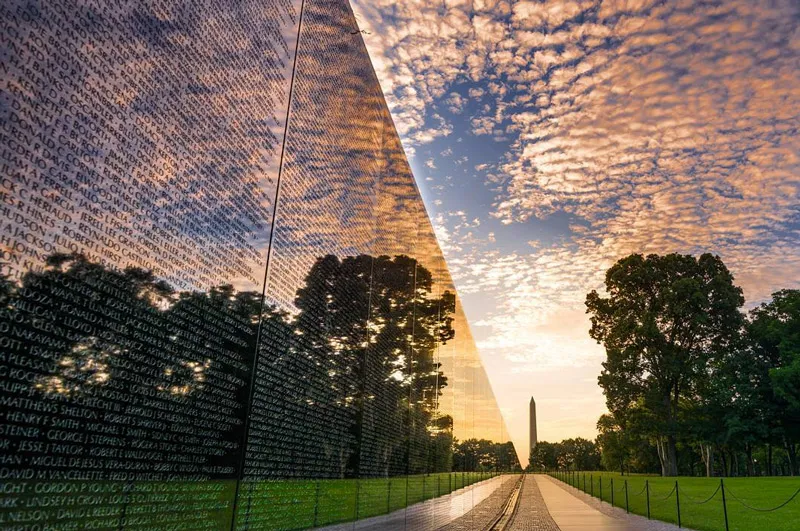
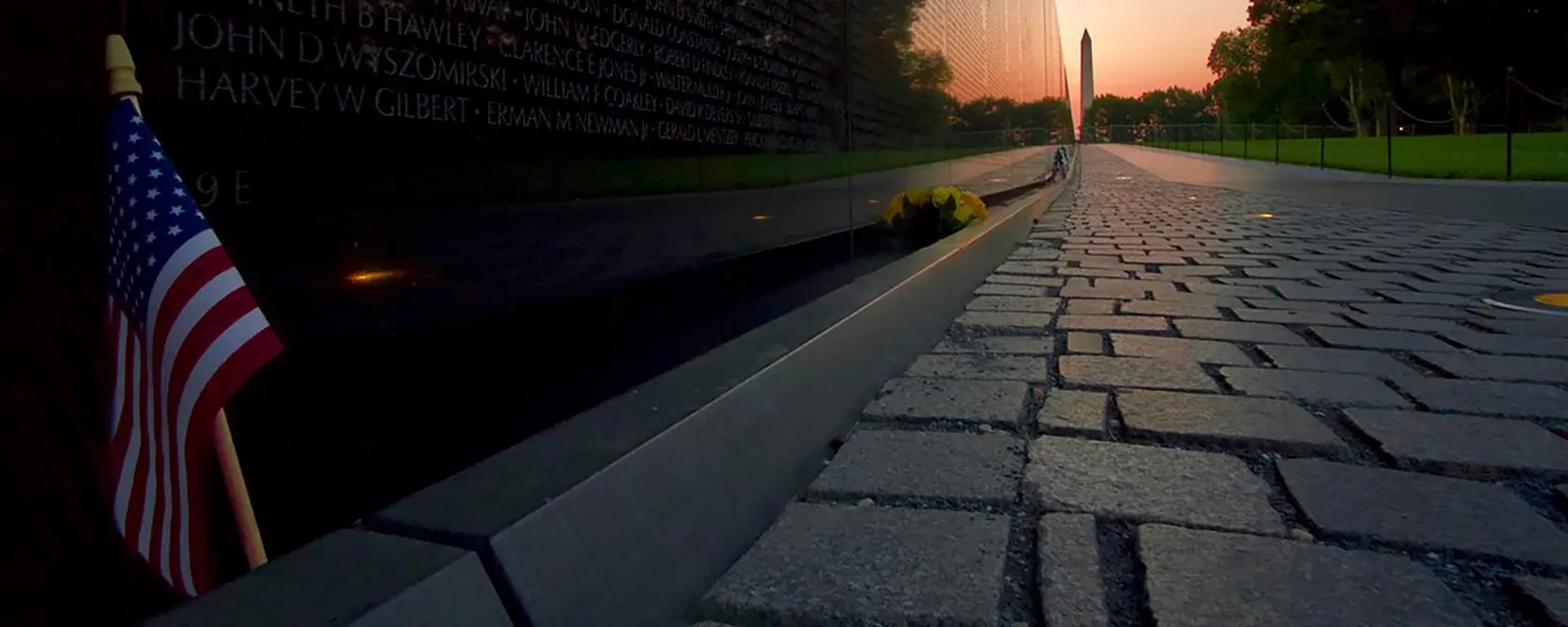
What is the Vietnam Veterans Memorial and where is it? The Vietnam Veterans Memorial on the National Mall pays tribute to the brave members of the U.S. Armed Forces who fought in the Vietnam War and were killed or missing in action. The memorial consists of three separate parts: The Three Soldiers statue, the Vietnam Women’s Memorial and the Vietnam Veterans Memorial Wall, also known as The Wall That Heals, which is the most popular feature. The memorial is free and open to the public 24 hours a day, with rangers on duty to answer questions from 9:30 a.m. to 10 p.m. daily. Interpretive programs are provided throughout the day and upon request. You’ll find the memorial located near Constitution Gardens on the National Mall. The closest Metro stops are Foggy Bottom or Federal Triangle on the Orange, Blue and Silver lines. Visitors can also get to the memorial via the DC Circulator’s National Mall route and Metrobus routes 32, 34 and 36. One of the nation’s most poignant war memorials The Vietnam Veterans Memorial Wall provides one of the National Mall’s most powerful scenes. In truth, the “wall” is actually made up of two identical walls that each stretch 246 feet and 9 inches, containing more than 58,000 names. The names are listed in chronological order based on the date of casualty, and within each day, names are shown in alphabetical order. Perhaps the memorial wall’s most defining characteristic is a visitor’s ability to see his or her reflection at the same time as the engraved names, connecting the past and the present like few other monuments can. If you wish to spot the name of a relative or friend while there, search the Vietnam Veterans Memorial Fund’s Virtual Wall before you embark or find the on-site list. Just south of the Vietnam Veterans Memorial Wall is the Vietnam Women’s Memorial, which commemorates the 265,000 women that served in the Vietnam War, many of whom worked as nurses. The 2,000 pound bronze structure stands 15 feet tall and depicts three women attending to a wounded soldier, reflecting the unity required during the conflict. The third part of the Vietnam Veterans Memorial is The Three Soldiers (also known as The Three Servicemen) bronze statue, another moving reminder of the disparate groups that had to come together during the Vietnam War. Each of the three soldiers stands seven feet tall, situated on top of a one-foot granite base, and are arranged as if to show the three soldiers gazing upon the memorial wall at the names of their fellow comrades. Honoring veterans On any given visit, you may encounter former servicemen at the memorial. In fact, the Honor Flight Network is a non-profit dedicated to bringing vets, often elderly, to DC to visit the memorials which honor their service to the nation. These visits are often filled with emotions and help provide closure for veterans by reinforcing the importance of their service and sacrifice.
What's Open & Reopening in Washington, DC
Washington, DC is open for business The nation's capital is ready to welcome you. Proof of vaccination and masks are generally not required in Washington, DC, but visitors are encouraged to check with individual establishments about COVID-19 protocols. Find the latest information from the DC government at coronavirus.dc.gov. DC Travel & Testing Requirements Fully Vaccinated Visitors (or visitors who tested positive for COVID-19 in the previous 90 days) may: Travel to DC from domestic locations without quarantining unless showing symptoms of COVID-19. If traveling from an international location, visitors must show a negative test before boarding a flight to the U.S. and get tested 3-5 days following travel. Unvaccinated Visitors Unvaccinated or partially vaccinated travelers must follow COVID-19 testing and quarantining requirements for non-essential travel. General travel requirements for unvaccinated visitors include getting a COVID-19 test 1-3 days before visiting DC, getting a COVID-19 test 3-5 days after returning home from their trip and self-quarantining for 7 days after returning home. You do not need a COVID-19 test if traveling from Maryland and Virginia or in DC in less than 24 hours. Private institutions and local government officials may ask for proof of a negative test. If a traveler tests positive while in DC, they must complete their isolation before traveling home, and susceptible close contacts must complete a 10-day quarantine. Where you can get vaccinated: The DC Government has resources on where to get vaccinated, including pediatric vaccination pre-registration, lists of health centers offering the vaccine and transportation options. Add your zip code to the official vaccines.gov site to find a list of pharmacies, health clinics and hospitals offering vaccines near you. International Travel Starting Nov. 8, vaccinated international travelers were welcomed back to the U.S. Learn more about international travel guidance. You can also find the latest events and festivals on weekdays, weekends and this month. What's Open Museums/Attractions The DC government has allowed for unlimited capacity at museums and attractions, however individual entities may impose their own capacity limits. Visit the Smithsonian Institution’s website for all hours of operation, a full schedule and admission information. Most Smithsonian museums no longer require timed-entry passes. Free timed passes are still required at the National Museum of African American History and Culture and Smithsonian's National Zoo. Visitors to the Smithsonian museums do not have to wear masks. Please note that to accommodate staff shortages, some Smithsonian museums in DC are operating on a modified schedule. Some museums have temporarily closed one day out of the week. On Mondays, the Hirshhorn Museum and Sculpture Garden, Renwick Gallery, Smithsonian American Art Museum, National Portrait Gallery and National Museum of the American Indian are closed. On Tuesdays, the National Museum of Asian Art, National Museum of African Art and Arts and Industries Building are closed. The Anacostia Community Museum is open Wednesday through Saturday. Note: The National Air and Space Museum is closed for renovation until fall 2022, but its Steven F. Udvar-Hazy Center in Chantilly, Virginia, remains open daily. What's Open Right Now The U.S. Botanic Garden will fully reopen (including the Conservatory) on April 1 with free entrance and no timed pass requirement. For more information, including hours and safety protocols, visit the Garden's website. The U.S. Capitol Visitor Center will resume tours on Monday, March 28. All tours will be staff led and all requests must be submitted through a congressional office. Each office is allowed one tour per week during the hours of Monday-Friday, 10 a.m. to 2 p.m. Please note that the Capitol Visitor Center main entrance will remain closed. For more information, visit the Center's website. The Hirshhorn Museum has reopened. For more information regarding hours, timed entry and health protocols, visit the museum’s website. The Smithsonian Institution Building (“The Castle”) has reopened. For more information regarding hours and health protocols, visit the museum’s website. The Washington Monument has reopened to the public. The monument is open seven days a week from 9 a.m. to 5 p.m. Masks are required for everyone, regardless of vaccination status, inside the Washington Monument. Tickets will be available online only from recreation.gov; there will be no tickets distributed on site. Tickets become available daily at 10 a.m. for the next day’s visits (for example, if you are planning to visit on July 21, you can reserve tickets at recreation.gov beginning at 10 a.m. on July 20). Each ticket is good for up to four individuals in a group traveling together. There is a non-refundable reservation fee of $1 per ticket. The Library of Congress has reopened its Jefferson Building. Free, timed entry tickets are available Thursdays, Fridays and Saturdays. For more information, visit the Library's website. The Rotunda of the National Archives Building has reopened for viewing the Declaration of Independence, U.S. Constitution, and Bill of Rights, (with limited capacity of 25 percent), by timed reservations Friday through Monday only, from 10 a.m. to 2 p.m. Beginning Friday, July 2, the Museum will resume normal hours of 10 a.m. to 5:30 p.m, and expand to be open every day, but with the same reduced capacity. As of July 2, visitors will also be able to view the Magna Carta in the David M. Rubenstein Gallery. The National Museum of Natural History has reopened. For more information regarding hours, timed entry and health protocols, visit the museum’s website. The United States Holocaust Memorial Museum has reopened. For more information regarding hours, timed entry and safety protocols, visit the museum's website. The National Museum of the Marine Corps has reopened. For more information on safety protocols, visit the museum's website. The National Gallery of Art has reopened. For more information regarding hours, timed entry and safety protocols, visit the museum's website. Please note that the East Building is closed for renovations. The National Museum of African American History and Culture has reopened. For more information regarding hours, timed entry and safety protocols, visit the museum's website. The National Museum of American History has reopened. For more information regarding hours, timed entry and safety protocols, visit the museum's website. The National Museum of the American Indian has reopened. For more information regarding hours, timed entry and safety protocols, visit the museum's website. The Smithsonian's National Zoo has reopened. For more information regarding hours, timed entry and safety protocols, visit the Smithsonian unit's website. The National Portrait Gallery has reopened. For more information regarding hours, timed entry and safety protocols, visit the museum's website. The Smithsonian American Art Museum and its Renwick Gallery have both reopened. For more information regarding hours, timed entry and safety protocols, visit the museum's website. The National Air and Space Museum's Steven F. Udvar Hazy Center has reopened. For more information regarding hours, timed entry and safety protocols, visit the museum's website. The Hirshhorn's Sculpture Garden is open daily from 10 a.m. to 4:30 p.m. For more information, visit the Hirshhorn's website. The John F. Kennedy Center for the Performing Arts' indoor campus and THE REACH is open for visiting Monday through Sunday, 10 a.m. to midnight. Masking is required indoors, and proof of vaccination is required for all guests attending performances. Learn more. Glenstone is open Thursday-Sunday from 10 a.m. – 5 p.m. Visit the museum's website for more information. George Washington's Mount Vernon is open daily from 9 a.m. to 5 p.m. ARTECHOUSE is open daily from 10 a.m. to 10 p.m. Make sure to read its safety protocols before planning a trip. O Museum in The Mansion is open for tours, lodging, outdoor dining and shopping; the garden is open for reservations as well. Lincoln's Cottage has reopened for self-guided tours from Wednesday through Monday. Advance tickets are required. International Spy Museum is now open daily. Limited tickets are available and advanced purchase is recommended. Visit spymusuem.org. Kreeger Museum is open. You must get advance reservation tickets. Museum of the Bible is open daily from 10 a.m. to 5 p.m. Tickets are required. To learn more about the museum, visit its website. Big Bus Tours is offering tours every day of the week. For more information, visit its website. The Phillips Collection is open Tuesday through Sunday, 11 a.m.-6 p.m., timed tickets needed and guests must follow safety requirements. The museum requires proof of vaccination for all visitors ages 12-years-old and up, and requires visitors 16-year-old and up to have a photo ID. Planet Word is open Thursday through Sunday, 10 a.m. to 5 p.m. with last entry at 3:30 p.m. All visitors aged 2 and older are required to wear a mask, regardless of vaccination status. For more information about the museum's COVID-19 guidelines and to reserve passes, visit Planet Word's website. The National Building Museum is now open Friday through Monday, 11 a.m. to 4 p.m. All visitors aged 2 and older are required to wear a mask, regardless of vaccination status. For more information, visit the museum's website. Tudor Place has reopened for guided house tours and self-guided garden tours, Thursday through Sunday. Proof of vaccination is required for visitors aged 12 and older and masks are required indoors. For more information, visit the estate's website. Dream Aero is open from 12-7 p.m., Monday through Thursday, 11 a.m. to 8 p.m. on Friday and Saturday and 11 a.m. to 7 p.m. on Sunday. Visit its website for more information. Hillwood Estate, Museum & Gardens has reopened with proof of full vaccination required for entry. For more information regarding hours and safety protocols, visit the estate's website. Old Town Trolley Tours is now open, with tours departing hourly from 10 a.m. to 4 p.m. each day. You can also read about the company's safety policies. Ford's Theatre has reopened. The Petersen House and Aftermath Exhibits will remain closed. For more information regarding tickets and safety protocols, visit the Ford's Theatre website. The theater requires proof of vaccination and masks are required. The DC History Center is open on Fridays from 2-7 p.m. and on Saturdays from 12-5 p.m. Free, timed entry tickets are required. Visit the Center's website for more information. The National Bonsai & Penjing Museum at the U.S. National Arboretum has reopened. For more information, visit the museum's website. DC Design Tours is open and offering eight architectural walking tours around the District. Visit its website for a full calendar and to book your tour. Blue Fern Travel offers its Fork Tours from Thursday through Sunday on U Street and in Georgetown and Old Town Alexandria. A portion of all ticket sales is donated to Bread for the City. The National Law Enforcement Museum has reopened. For more information regarding hours, timed entry and health protocols, visit the museum’s website. DAR Museum (And DAR Library and DAR Constitution Hall) have reopened. For more information regarding hours, timed entry and health protocols, visit the website. The National Children's Museum has reopened. Advanced tickets are required and available for morning or afternoon sessions. For more information regarding hours, timed entry and health protocols, visit the museum's website. Anderson House - has reopened with proof of full vaccination required for entry. For more information regarding hours and safety protocols, visit the museum's website. The Washington National Cathedral is open for sightseeing, programs, and worship services. Theaters/Cinemas/Concert Venues/Entertainment Centers Most venues require proof of full vaccination from COVID-19. Check venue websites for more information. Theaters & Playhouses 20+ theaters now require proof of vaccination for entry. The Kennedy Center and Ford's Theatre requires proof of vaccination. Music & Concert Venues The Anthem - Upcoming shows 9:30 Club - Upcoming shows Merriweather Post Pavilion - Upcoming shows Lincoln Theatre - Upcoming shows Songbyrd Cafe - Upcoming shows Black Cat - Upcoming shows The Pocket - Upcoming shows Echostage - Upcoming shows Union Stage - Upcoming shows Pearl Street Warehouse - Upcoming shows DC9 Nightclub - Upcoming shows Blues Alley - Upcoming shows Hamilton Live - Upcoming shows Capital One Arena - Upcoming events The Howard Theatre - Upcoming events Restaurants Dining establishments are open to the public. Due to the popularity of DC's dining scene, it's always recommended to reserve your table in advance online. Guests may wear a mask if they would like, but there's no requirement to do so. For diners who prefer to eat outdoors during the pandemic, check out these al fresco options: beer gardens, patios and rooftop restaurants. Parks/Gardens/Recreation Dog parks, golf courses, parks, tennis courts, tracks and fields are open. Recreation centers, bowling alleys, climbing gyms, squash or racquetball clubs, skating rinks and skateboard parks also no longer have any capacity restrictions. Outdoor attractions like the National Park Service Sites, Monuments and Memorials at the National Mall and around the city are open. Learn more about DC's parks and gardens and read details about the status of recently reopened sights below. The John F. Kennedy Center for the Performing Arts' outdoor campus at THE REACH is accessible, including pop-up wine garden and cafe Victura Park. Kenilworth Park & Aquatic Gardens is open from 8 a.m. to 4 p.m., with limited number of visitors. Onsite buildings and bathroom are closed. Learn more. The Smithsonian's Enid A. Haupt Garden is open with safety protocols in place. Learn more. U.S. National Arboretum has reopened from 8 a.m. to 5 p.m. Learn more. George Washington's Mount Vernon is open daily from 9 a.m. to 5 p.m. The Fields & Festival Grounds at RFK Campus are open from 10 a.m. to 9 p.m. on weekdays and 10 a.m. to 8 p.m. on weekends. The weekly farmers' market is open. Learn more. The Bartholdi Fountain and Gardens and the Terrace Gardens at the U.S. Botanic Garden, but the indoor Conservatory and gated outdoor gardens are temporarily closed. Learn more. Retail Capacity restrictions have been lifted at nonessential retail businesses, hair and nail salons, massage and spas. Note that individual businesses may enforce their own health precautions. Many Made in DC shops offer online shopping with the option for curbside pickup. Check out ways that you can support some of these local businesses in the District. Hotels If you find yourself in Washington, DC during this time and in need of a hotel, many DC-area hotels are open and ready to welcome guests. You can also take advantage of special deals and peruse locations that are ideal for sports fans, history buffs, families with kids and more. Transportation WMATA's enhanced cleaning measures include daily disinfecting of trains, buses and stations with mopping, wiping down high-touch surfaces or using electrostatic foggers. Metro has upped its deep cleaning of stations to four times that of the pre-Covid era. In addition, Metro launched new touch-free SmarTrip service for iPhone and Apple Watch devices, becoming the first rail system in the U.S. to offer a full service, touch-free payment option at every single stop. Metro has restored most rail and bus service to pre-covid levels across the region in the largest – and likely most complex – service change in the system's 44-year history. Metro is expanding late-night service and restoring more routes to support the DC region’s reopening and recovery. Face masks are no longer required. For more information, visit wmata.com. What's Closed Belmont-Paul Women's Equality National Monument - Closed to the public until further notice. Madame Tussauds - Closed to the public until further notice. Old Post Office Tower - Closed to the public until further notice. Pentagon Tours - Closed to the public until further notice. National Inventors Hall of Fame Museum - Closed to the public until further notice. National Guard Memorial Museum - Closed to the public until further notice.