
All Articles

Guide to Visiting the Washington Monument
Built to honor George Washington, the Continental Army's commander-in-chief and the first United States president, the Washington Monument was once the tallest building in the world at just over 555 feet. The monument to America’s first president still holds the title of the world’s tallest stone structure and obelisk. The New & Improved Washington Monument After years of renovations and reopening in 2019, the Washington Monument has raised expectations for visitors with a new state-of-the-art elevator that will efficiently move hundreds of visitors up to the observation deck daily. The minute-long ride up 50 stories to the top of the world's tallest free-standing stone structure includes a video from the National Park Service about what to expect. From the observation deck, you can see nearly 25 miles into the horizon in every direction, including landmarks like the U.S. Capitol, the White House, Arlington National Cemetery and the Washington National Cathedral. Part of what makes traveling in the elevator so historic is that, on the two-minute descent, it offers a glimpse of the interior walls, which are lined with stones that commemorate George Washington, placed by states, civic groups and others. The modern system gives the National Park Service operators better control of the elevator with remote access from the ground. Before experiencing the new elevator, visitors will encounter another improvement to traveling to the top of the Washington Monument – an upgraded security screening facility at the base of the structure. The new security structure can accommodate up to 20 visitors and has more modern screening equipment. The Washington Monument is open 9 a.m. to 5 p.m. daily (last available tour ticket is at 4 p.m.) except for December 25, July 4 and part of July 3. Visitors can reserve tickets on recreation.gov in advance. A limited number of walk-up tickets are available on a first-come, first-serve basis beginning at 8:45 a.m. outside of the Washington Monument Lodge. Find out more information with our Washington Monument tour and ticket guide for both groups and individuals. More on the Washington Monument Maintained by the National Park Service, the Washington Monument is located on the center of the National Mall between the U.S. Capitol and the Lincoln Memorial. The easiest way to get to the monument is by taking the Metro. The two closest Metro stops are Federal Triangle and Smithsonian, both on the Blue, Orange and Silver lines. If traveling by bus, take DC Circulator’s National Mall route or ride Metrobus routes 32, 34, or 36. If driving, visitor parking is available on Ohio Drive, between the Lincoln and Jefferson memorials. Note that street parking is often limited near the National Mall. Why does the Washington Monument have two colors? It wasn't easy to build Washington Monument. The structure was originally designed by Robert Mills, with construction beginning in 1848. The combination of the Civil War, the Know Nothing Party's rise to control of the Washington National Monument Society through an illegal election and lack of funding led to a halt in construction in 1854. When construction resumed in 1879, marble was used from a different quarry, and time and weather erosion led to the difference in color, which begins at the 150-foot mark. The monument was finally completed in 1884 by Thomas Casey and the U.S. Army Corps of Engineers and an elevator was added to the monument in 1889.
How Can I Tour the Monuments & Memorials in Washington, DC?
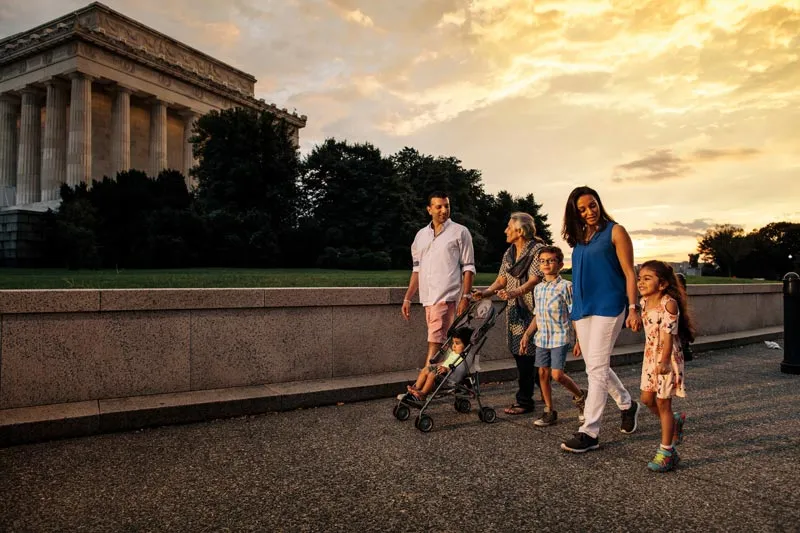
Touring DC’s iconic attractions When you come to DC, especially if you’re a first-time visitor, it’s likely that our world-famous monuments and memorials will be at the top of your must-see list. Most of these major attractions are located on the National Mall, which extends from the U.S. Capitol to the Lincoln Memorial, with many of them running along Constitution Avenue. Many of the monuments and memorials are open 24-hours a day, 365-days-a-year and you do not need to make advance reservations. These include the Lincoln Memorial, Jefferson Memorial, National World War II Memorial, the Martin Luther King, Jr. Memorial, the FDR Memorial and the Vietnam Veterans Memorial. These National Park Service (NPS)-run memorials are usually staffed by NPS Rangers who can answer your questions from 9:30 a.m. - 10 p.m. Rangers also conduct various tours and special programming throughout the year. Visit the National Mall calendar page for more information. Tours that require tickets There are several major attractions that do require advance tickets. These tickets are usually free or have a minimal charge. Tickets are required to go to the top of the recently reopened Washington Monument. Tickets may be ordered online for tour dates up to 90 days in advance, while additional tickets listed as "Not Yet Released" are made available the day prior to the desired tour date at 10 a.m. EST. Same-day tickets are also available on a first-come, first-served basis daily starting at 8:30 a.m. at the Washington Monument Lodge, located on 15th Street between Madison Drive NW and Jefferson Drive SW. Tours of the U.S. Capitol also need to be arranged in advance. Free reservations can be made via the visitthecapitol.gov website. Guided tours begin at the Capitol Visitor Center and include a 13-minute intro film, along with visits to the Crypt, the Rotunda and National Statuary Hall. Visitors can also request a staff-led tour through their Senator or Congress person. When court is not in session, visitors can take free, self-guided tours of the Supreme Court. Trained docents are on-hand to give courtroom lectures every 30-minutes from 9:30 a.m. - 3:30 p.m. on weekdays. Visitors are also invited to attend oral arguments when court is in session. These seats are extremely limited. Visitors must wait in line the morning of a courtroom session. See the Visitor’s Guide to Oral Arguments page for more information. Admission to both the Bureau of Engraving and Printing (see where U.S. dollars are made!) and the National Archives (home of the original U.S. Constitution, Declaration of Independence and Bill of Rights) are free and open to the public. In busier months, you’ll need to queue in an outdoor line to get inside. Please visit our touring the White House guide for more information on booking a tour (Note: these tours must be booked well in advance). Great options for guided tours The highly acclaimed Unlimited Biking offers daily, three-hour guided bicycle tours of the monuments with stops at all of the major attractions along the National Mall. Unlimited Biking also offers tours after dark so that visitors can experience magnificent views of the attractions illuminated at night. Big Bus Tours offers open-top sightseeing tours of the National Mall. Enjoy 24 or 48-hour hop-on, hop-off tours of the city's iconic landmarks. Along the way, you can learn about the city's history while listening to the entertaining and informative commentary. Your hop-on, hop-off ticket also allows you to exit the bus to explore and visit attractions up-close. Get an exclusive discount and save big on your next Big Bus Tour. Just enter the promotional code VISITDC for the best available deal and start exploring the nation's capital. Adventure DC Tricycle Tours offers live and entertaining historical narration as they transport you via pedicab to each monument and memorial. You can enjoy a customized tour that is pet-, child-, and mobility-impaired-friendly. Additionally, private golf cart and electric scooter tours are available. Public scooter tours are open to the general public on Saturdays, with limited availability. The code "DCFUN" will secure a discount on the public scooter tour. Cruise around the nation's capital in style on Washington, DC Urban Adventures' unique electric vehicles, where you can see the monuments and memorials on the National Mall by day or night. For a truly unique way to see the city, Capital Segway Tours offers guided experiences of the National Mall and surrounding sites. Visitors glide across town on a Segway, all while taking in the sites of Washington, DC. DC by Foot offers free, tip-based walking tours of Washington, DC. These informative tours are conducted by expert guides who make it fun and educational. In addition to the National Mall, DC by Foot takes visitors to the Tidal Basin, Pennsylvania Avenue and Capitol Hill. Visitors can also learn all about President Lincoln’s assassination or about Washington’s secrets and scandals. Contact Fiat Luxe Tours for an exciting private tour experience along the National Mall. Whether you want to learn the history of DC's most iconic landmarks or find the most perfect photo-ops, Fiat Luxe Tours has a tour for you. The company also conducts custom-made tours, too.

QA Test Automated cron Article sync 1
As you return to traveling this year, Washington, DC should be at the very top of your list. The nation’s capital offers more than 100 free things to do, but it should come as no surprise that museums are some of the most popular attractions. We’ve gone into deep detail on four of the city’s most popular museums (including one dedicated to living animals), none of which charge admission. Find the latest updates on visiting museums, including Smithsonian's plans to have all of its museums open by the end of August 2021, mask mandates for all indoor museums and the latest ticketing requirements. Book your next vacation to the nation’s capital and visit these only-in-the-District museums, free of charge. In the heart of the nation’s capital lives a portal to wildlife from around the world. Smithsonian’s National Zoo offers a firsthand, family-friendly experience through a 163-acre urban park in the Woodley Park neighborhood teeming with roughly 2,700 animals that represent more than 390 species. The zoo is also connected to the Smithsonian Conservation Biology Institute (a non-public facility located in Front Royal, Va.), a global effort to conserve species and train future conservationists. This focus on preserving endangered animals extends to the zoo, as one-fifth of its exhibited species fall into this category. In the heart of the nation’s capital lives a portal to wildlife from around the world. Smithsonian’s National Zoo offers a firsthand, family-friendly experience through a 163-acre urban park in the Woodley Park neighborhood teeming with roughly 2,700 animals that represent more than 390 species. The zoo is also connected to the Smithsonian Conservation Biology Institute (a non-public facility located in Front Royal, Va.), a global effort to conserve species and train future conservationists. This focus on preserving endangered animals extends to the zoo, as one-fifth of its exhibited species fall into this category. In the heart of the nation’s capital lives a portal to wildlife from around the world. Smithsonian’s National Zoo offers a firsthand, family-friendly experience through a 163-acre urban park in the Woodley Park neighborhood teeming with roughly 2,700 animals that represent more than 390 species. The zoo is also connected to the Smithsonian Conservation Biology Institute (a non-public facility located in Front Royal, Va.), a global effort to conserve species and train future conservationists. This focus on preserving endangered animals extends to the zoo, as one-fifth of its exhibited species fall into this category. In the heart of the nation’s capital lives a portal to wildlife from around the world. Smithsonian’s National Zoo offers a firsthand, family-friendly experience through a 163-acre urban park in the Woodley Park neighborhood teeming with roughly 2,700 animals that represent more than 390 species. The zoo is also connected to the Smithsonian Conservation Biology Institute (a non-public facility located in Front Royal, Va.), a global effort to conserve species and train future conservationists. This focus on preserving endangered animals extends to the zoo, as one-fifth of its exhibited species fall into this category. In the heart of the nation’s capital lives a portal to wildlife from around the world. Smithsonian’s National Zoo offers a firsthand, family-friendly experience through a 163-acre urban park in the Woodley Park neighborhood teeming with roughly 2,700 animals that represent more than 390 species. The zoo is also connected to the Smithsonian Conservation Biology Institute (a non-public facility located in Front Royal, Va.), a global effort to conserve species and train future conservationists. This focus on preserving endangered animals extends to the zoo, as one-fifth of its exhibited species fall into this category. In the heart of the nation’s capital lives a portal to wildlife from around the world. Smithsonian’s National Zoo offers a firsthand, family-friendly experience through a 163-acre urban park in the Woodley Park neighborhood teeming with roughly 2,700 animals that represent more than 390 species. The zoo is also connected to the Smithsonian Conservation Biology Institute (a non-public facility located in Front Royal, Va.), a global effort to conserve species and train future conservationists. This focus on preserving endangered animals extends to the zoo, as one-fifth of its exhibited species fall into this category. In the heart of the nation’s capital lives a portal to wildlife from around the world. Smithsonian’s National Zoo offers a firsthand, family-friendly experience through a 163-acre urban park in the Woodley Park neighborhood teeming with roughly 2,700 animals that represent more than 390 species. The zoo is also connected to the Smithsonian Conservation Biology Institute (a non-public facility located in Front Royal, Va.), a global effort to conserve species and train future conservationists. This focus on preserving endangered animals extends to the zoo, as one-fifth of its exhibited species fall into this category. In the heart of the nation’s capital lives a portal to wildlife from around the world. Smithsonian’s National Zoo offers a firsthand, family-friendly experience through a 163-acre urban park in the Woodley Park neighborhood teeming with roughly 2,700 animals that represent more than 390 species. The zoo is also connected to the Smithsonian Conservation Biology Institute (a non-public facility located in Front Royal, Va.), a global effort to conserve species and train future conservationists. This focus on preserving endangered animals extends to the zoo, as one-fifth of its exhibited species fall into this category. In the heart of the nation’s capital lives a portal to wildlife from around the world. Smithsonian’s National Zoo offers a firsthand, family-friendly experience through a 163-acre urban park in the Woodley Park neighborhood teeming with roughly 2,700 animals that represent more than 390 species. The zoo is also connected to the Smithsonian Conservation Biology Institute (a non-public facility located in Front Royal, Va.), a global effort to conserve species and train future conservationists. This focus on preserving endangered animals extends to the zoo, as one-fifth of its exhibited species fall into this category. In the heart of the nation’s capital lives a portal to wildlife from around the world. Smithsonian’s National Zoo offers a firsthand, family-friendly experience through a 163-acre urban park in the Woodley Park neighborhood teeming with roughly 2,700 animals that represent more than 390 species. The zoo is also connected to the Smithsonian Conservation Biology Institute (a non-public facility located in Front Royal, Va.), a global effort to conserve species and train future conservationists. This focus on preserving endangered animals extends to the zoo, as one-fifth of its exhibited species fall into this category. In the heart of the nation’s capital lives a portal to wildlife from around the world. Smithsonian’s National Zoo offers a firsthand, family-friendly experience through a 163-acre urban park in the Woodley Park neighborhood teeming with roughly 2,700 animals that represent more than 390 species. The zoo is also connected to the Smithsonian Conservation Biology Institute (a non-public facility located in Front Royal, Va.), a global effort to conserve species and train future conservationists. This focus on preserving endangered animals extends to the zoo, as one-fifth of its exhibited species fall into this category. In the heart of the nation’s capital lives a portal to wildlife from around the world. Smithsonian’s National Zoo offers a firsthand, family-friendly experience through a 163-acre urban park in the Woodley Park neighborhood teeming with roughly 2,700 animals that represent more than 390 species. The zoo is also connected to the Smithsonian Conservation Biology Institute (a non-public facility located in Front Royal, Va.), a global effort to conserve species and train future conservationists. This focus on preserving endangered animals extends to the zoo, as one-fifth of its exhibited species fall into this category. In the heart of the nation’s capital lives a portal to wildlife from around the world. Smithsonian’s National Zoo offers a firsthand, family-friendly experience through a 163-acre urban park in the Woodley Park neighborhood teeming with roughly 2,700 animals that represent more than 390 species. The zoo is also connected to the Smithsonian Conservation Biology Institute (a non-public facility located in Front Royal, Va.), a global effort to conserve species and train future conservationists. This focus on preserving endangered animals extends to the zoo, as one-fifth of its exhibited species fall into this category. In the heart of the nation’s capital lives a portal to wildlife from around the world. Smithsonian’s National Zoo offers a firsthand, family-friendly experience through a 163-acre urban park in the Woodley Park neighborhood teeming with roughly 2,700 animals that represent more than 390 species. The zoo is also connected to the Smithsonian Conservation Biology Institute (a non-public facility located in Front Royal, Va.), a global effort to conserve species and train future conservationists. This focus on preserving endangered animals extends to the zoo, as one-fifth of its exhibited species fall into this category. In the heart of the nation’s capital lives a portal to wildlife from around the world. Smithsonian’s National Zoo offers a firsthand, family-friendly experience through a 163-acre urban park in the Woodley Park neighborhood teeming with roughly 2,700 animals that represent more than 390 species. The zoo is also connected to the Smithsonian Conservation Biology Institute (a non-public facility located in Front Royal, Va.), a global effort to conserve species and train future conservationists. This focus on preserving endangered animals extends to the zoo, as one-fifth of its exhibited species fall into this category. In the heart of the nation’s capital lives a portal to wildlife from around the world. Smithsonian’s National Zoo offers a firsthand, family-friendly experience through a 163-acre urban park in the Woodley Park neighborhood teeming with roughly 2,700 animals that represent more than 390 species. The zoo is also connected to the Smithsonian Conservation Biology Institute (a non-public facility located in Front Royal, Va.), a global effort to conserve species and train future conservationists. This focus on preserving endangered animals extends to the zoo, as one-fifth of its exhibited species fall into this category. In the heart of the nation’s capital lives a portal to wildlife from around the world. Smithsonian’s National Zoo offers a firsthand, family-friendly experience through a 163-acre urban park in the Woodley Park neighborhood teeming with roughly 2,700 animals that represent more than 390 species. The zoo is also connected to the Smithsonian Conservation Biology Institute (a non-public facility located in Front Royal, Va.), a global effort to conserve species and train future conservationists. This focus on preserving endangered animals extends to the zoo, as one-fifth of its exhibited species fall into this category. In the heart of the nation’s capital lives a portal to wildlife from around the world. Smithsonian’s National Zoo offers a firsthand, family-friendly experience through a 163-acre urban park in the Woodley Park neighborhood teeming with roughly 2,700 animals that represent more than 390 species. The zoo is also connected to the Smithsonian Conservation Biology Institute (a non-public facility located in Front Royal, Va.), a global effort to conserve species and train future conservationists. This focus on preserving endangered animals extends to the zoo, as one-fifth of its exhibited species fall into this category. In the heart of the nation’s capital lives a portal to wildlife from around the world. Smithsonian’s National Zoo offers a firsthand, family-friendly experience through a 163-acre urban park in the Woodley Park neighborhood teeming with roughly 2,700 animals that represent more than 390 species. The zoo is also connected to the Smithsonian Conservation Biology Institute (a non-public facility located in Front Royal, Va.), a global effort to conserve species and train future conservationists. This focus on preserving endangered animals extends to the zoo, as one-fifth of its exhibited species fall into this category. In the heart of the nation’s capital lives a portal to wildlife from around the world. Smithsonian’s National Zoo offers a firsthand, family-friendly experience through a 163-acre urban park in the Woodley Park neighborhood teeming with roughly 2,700 animals that represent more than 390 species. The zoo is also connected to the Smithsonian Conservation Biology Institute (a non-public facility located in Front Royal, Va.), a global effort to conserve species and train future conservationists. This focus on preserving endangered animals extends to the zoo, as one-fifth of its exhibited species fall into this category. In the heart of the nation’s capital lives a portal to wildlife from around the world. Smithsonian’s National Zoo offers a firsthand, family-friendly experience through a 163-acre urban park in the Woodley Park neighborhood teeming with roughly 2,700 animals that represent more than 390 species. The zoo is also connected to the Smithsonian Conservation Biology Institute (a non-public facility located in Front Royal, Va.), a global effort to conserve species and train future conservationists. This focus on preserving endangered animals extends to the zoo, as one-fifth of its exhibited species fall into this category. In the heart of the nation’s capital lives a portal to wildlife from around the world. Smithsonian’s National Zoo offers a firsthand, family-friendly experience through a 163-acre urban park in the Woodley Park neighborhood teeming with roughly 2,700 animals that represent more than 390 species. The zoo is also connected to the Smithsonian Conservation Biology Institute (a non-public facility located in Front Royal, Va.), a global effort to conserve species and train future conservationists. This focus on preserving endangered animals extends to the zoo, as one-fifth of its exhibited species fall into this category. In the heart of the nation’s capital lives a portal to wildlife from around the world. Smithsonian’s National Zoo offers a firsthand, family-friendly experience through a 163-acre urban park in the Woodley Park neighborhood teeming with roughly 2,700 animals that represent more than 390 species. The zoo is also connected to the Smithsonian Conservation Biology Institute (a non-public facility located in Front Royal, Va.), a global effort to conserve species and train future conservationists. This focus on preserving endangered animals extends to the zoo, as one-fifth of its exhibited species fall into this category.
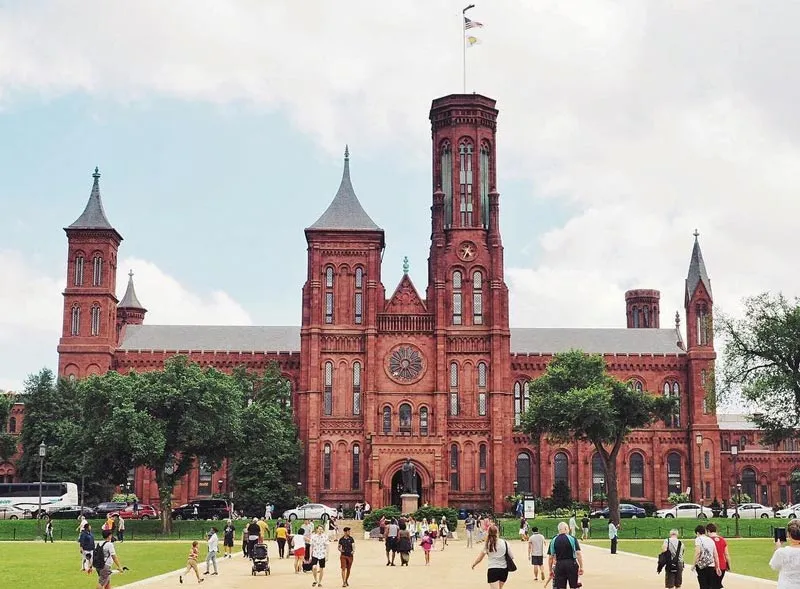
The Smithsonian Castle: Gateway to Museums & History
Brit benefactor and an American castle For a man who never set foot in Washington, DC, French-born, British-raised James Smithson has had a huge impact on the city. The British scientist (1765-1829), an illegitimate son of a Duke, left his considerable fortune to a nephew with the stipulation that, were the nephew to die without heirs, the money go “to the United States of America, to found at Washington, under the name of the Smithsonian Institution, an establishment for the increase and diffusion of knowledge.” The nephew died, and a museum complex was born. Why did Smithson leave such a large bequest to a place he’d never been? It’s a mystery, but theories abound. Perhaps he felt delegitimized by his homeland? Maybe he felt the U.S. might further science better than Europe? The result of that gift, The Smithsonian Institution, was officially created by an act of Congress in 1846. Its first building, the distinctive red Maryland sandstone Smithsonian Castle, was completed in 1855. The towered, neo-Gothic structure, designed by up-and-coming New York City architect James Renwick, initially held the entire institution: a gallery, a natural history collection, a laboratory and even the first secretary of the organization’s apartment. What’s inside the Smithsonian Castle? While the Victorian arches and dark woodwork of the Castle suggest a bygone era, it now holds a thoroughly modern visitors center with interactive 3-D maps pinpointing and detailing the 17 DC-area Smithsonian Institution properties, including museums, galleries and the National Zoological Park. Since most are on the adjacent National Mall, the maps can be particularly helpful for plotting a day of museum-hopping. Docents also man a help desk and distribute printed guides. There’s also a coffee and snack shop and a large seating area with free Wi-Fi, an ideal place to take a break and plan your next move, be it bug-viewing at the National Museum of Natural History or a dip into contemporary art the Hirshhorn Museum and Sculpture Garden. Also housed in the grand, church-like structure is the exhibit A Castle of Curiosities, delving into the history of the castle and the little that is known of Smithson’s life. In the high-ceilinged rooms beyond, another exhibit, Welcome to the Smithsonian, holds art and artifacts representing all of the institution’s members in old-timey gleaming wooden display cases. Look out for the National Zoo’s “panda cam” showing its popular bears and ancient buddhas from the Sackler Gallery. Perhaps most touching, the Castle also holds James Smithson’s crypt. Though he died in Genoa, Italy and was buried there, in 1905, he was reinterred in a marble crypt in a small, chapel-like room here. Pay tribute to him here, or by visiting the many museums his vision launched.