
All Articles

Visiting the Marine Corps War Memorial
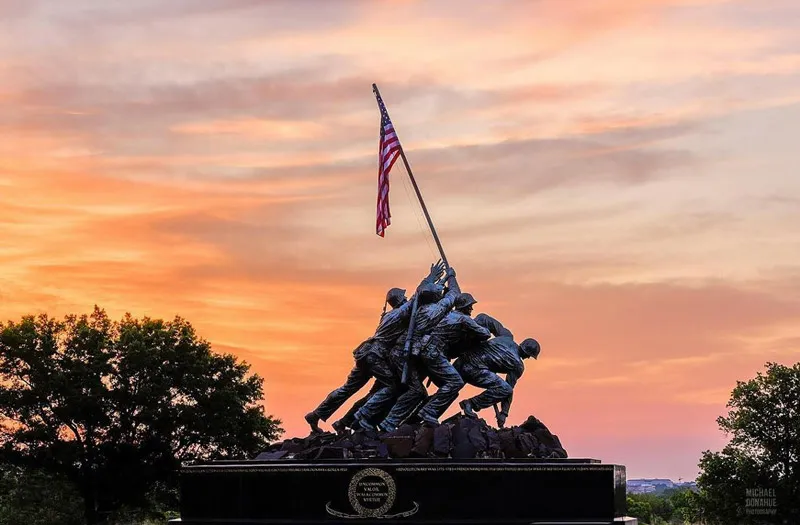
The U.S. Marine Corps War Memorial's world-famous statue, which is based on the iconic photograph taken by Associated Press photographer Joe Rosenthal, depicts the six Marines who raised of the second American flag at Iwo Jima in the Japanese Volcano Islands on February 23, 1945, signifying the conclusion of the American campaign in the Pacific during World War II. The memorial is dedicated to “the Marine dead of all wars and their comrades of other services who fell fighting beside them.” The memorial was dedicated on November 10, 1954 by President Dwight D. Eisenhower and the American flag has flown from the statue 24 hours a day, 365 days a year by presidential proclamation ever since. The bronze statue was made by sculptor Felix W. de Weldon. He worked with the three surviving Marines from the battle, Rene A. Gagnon, Ira Hayes and John H. Bradley, to model their faces in clay. The base of the memorial is engraved with every major battle involving the U.S. Marine Corps since 1775. Getting to the Marine Corps War Memorial The Iwo Jima Memorial is located outside of Arlington National Cemetery in Arlington Ridge Park in Virginia, just across the Potomac River from Washington, DC. The memorial can be accessed by car via the VA-110 South route or US-50 East or West routes. Parking is available at the memorial. If you take Metro, get off at either the Rosslyn station (Orange, Silver or Blue lines) or Arlington National Cemetery station (Blue Line). It is a 10-15 minute walk from either of these stations. What to do at the Marine Corps Memorial The grounds of the Marine Corps War Memorial are open from 6 a.m. until midnight, year-round. National Park Ranger-led programs can be requested in advance by calling 703-235-1530. During the summer on Tuesday evenings, the U.S. Marine Corps band performs free hour-long drum and bugle concerts called Sunset Parades. During the Sunset Parades, parking is not permitted on the memorial grounds, but visitors may park at Arlington National Cemetery Visitors Center and take a shuttle to the grounds. The view from the Iwo Jima Memorial is also one of the best spots to snap a photo of the iconic panorama of the Lincoln Memorial, Washington Monument and U.S. Capitol.
Visiting the National 9/11 Pentagon Memorial
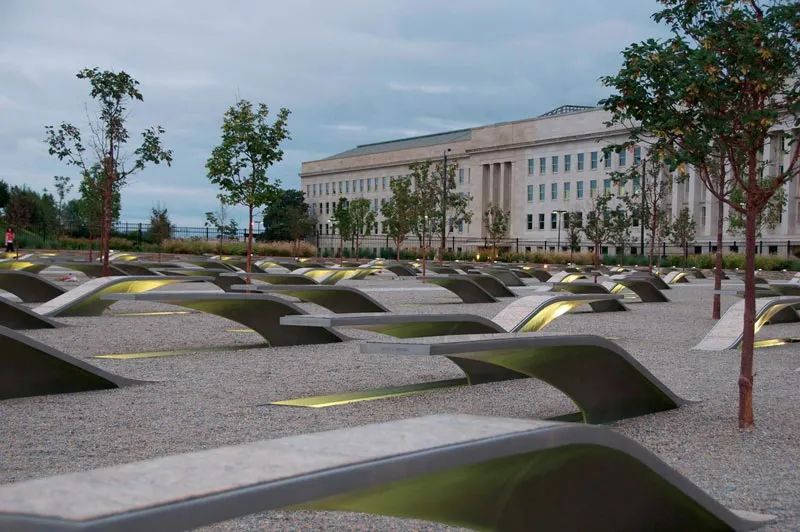
Where and what is the National 9/11 Pentagon Memorial? The National 9/11 Pentagon Memorial is a national memorial dedicated to the tragic events that occurred on Sept. 11, 2001. All 184 lives lost in the attack on the Pentagon are represented by “Memorial Unit” benches. Surrounding the benches are 85 Crape Myrtles (trees that will grow up to 30 feet tall) and the Age Wall, which grows one inch in height per year relative to the ages of the victims. The memorial is located just outside the Pentagon, which has limited parking, meaning the best way to reach the site is to take the Metrorail to the Pentagon or Pentagon City stops on the Blue and Yellow lines and walk from there. The memorial is free and is usually open to the public 24 hours a day, 365 days a year. The public restrooms by the entrance are open from 7 a.m. – 10 p.m. What will I see at the National 9/11 Pentagon Memorial? The Pentagon Memorial has an emotive power that few other memorials have, due to both the recency of the tragedy it pays homage to and its comprehensive listing of victims. When first approaching the expansive Memorial Gateway, visitors will spot a black granite stone stating the date and time of the tragic plane crash: Sept. 11, 2001 at 9:47 a.m. Words describe its purpose: “We claim this ground in remembrance of the events of September 11, 2001, to honor the 184 people whose lives were lost, their families, and all who sacrifice that we may live in freedom. We will never forget.” Each of the aforementioned Memorial Units (or benches) has a victim’s age and location at the time of the attack inscribed on it. The benches are arranged along an age line, according to the year each victim was born. They are positioned to differentiate those who were on board American Airlines Flight 77 and those who were in the Pentagon, and each contains a pool of water that reflects light in the evenings. The units honoring victims on board Flight 77 face the direction of the plane’s approach to the Pentagon, while those reading the names of Pentagon victims face the plane’s point of impact on the Pentagon’s south facade. To learn more about the National 9/11 Pentagon Memorial, visit the memorial's website.