
All Articles
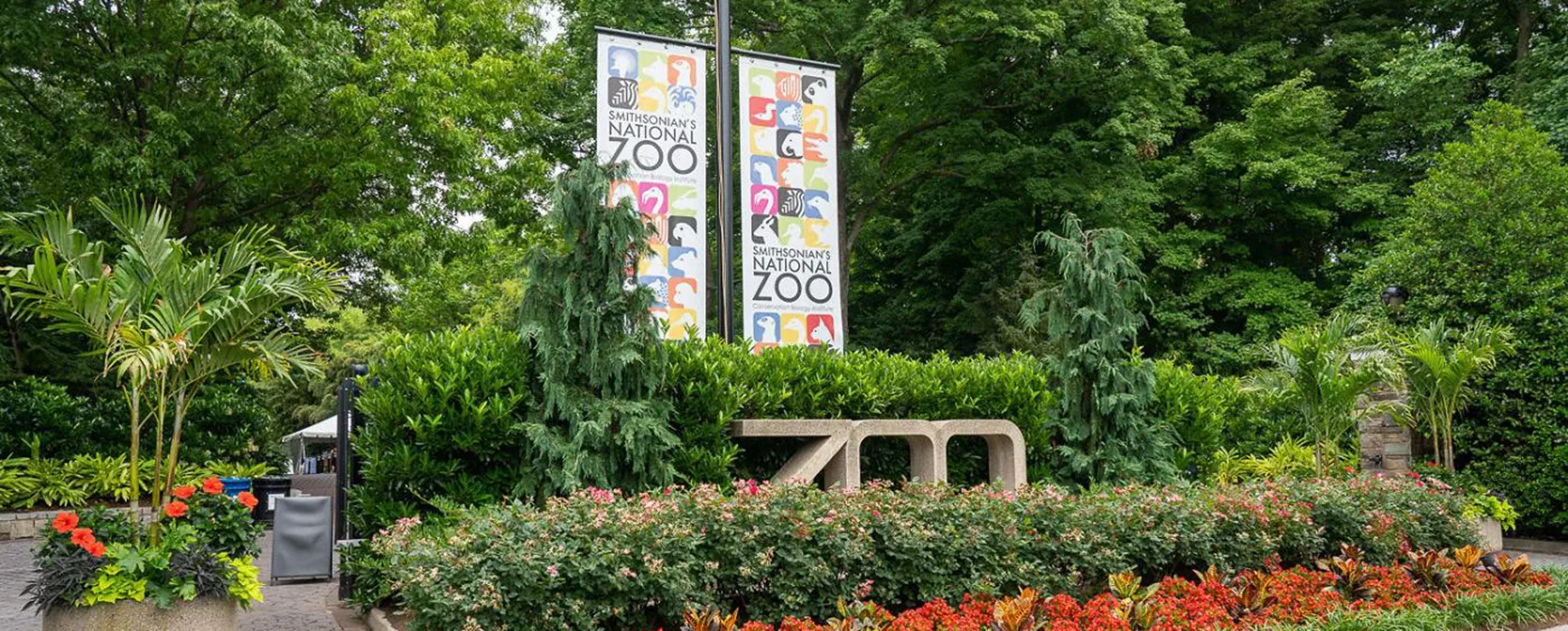
Visiting Smithsonian's National Zoo in Washington, DC
It’s not all elephants and donkeys in DC. At the National Zoo, visitors can find all sorts of animals that don’t subscribe to party lines. Lions, tigers and giraffes are just some of the 1,500-plus animals that call the 163-acre park home. The zoo’s habitats feature animals from 300 different species and about 25 percent of the zoo’s residents are endangered. All of the animals at the National Zoo – which is also a global research center and conservation center – are cared for by world-class zoologists and veterinarians. At the end of 2024, The roster of animals again includes two giant pandas. Bao Li and Qing Bao, both two years old, have moved into their new digs at the Zoo, with the public able to view on Jan. 24, 2025 (a member preview runs Jan. 10-19). The National Zoo is located in DC’s residential Woodley Park neighborhood and, like all Smithsonian museums, admission is free. The main entrance (you’ll know it by the two Instagram-friendly lion statues flanking the gate) is on Connecticut Avenue. The zoo is just a short walk from both the Woodley Park and Cleveland Park Metro stops on the Red Line and the L1 and L2 buses drop off right in front of the entrance. Be prepared to do lots of walking! The National Zoo, which is handicapped and stroller accessible, is a large park with 18 distinct areas to explore. Meet the animals at the National Zoo You’ll find animals from all over the world in various exhibits that are open like the Elephant Trails, Great Ape House, Cheetah Conservation Station and American Trail. Check out the National Zoo map for specifics. Special events and programming for the whole family With world-class zoologists and conservationists on staff, every day offers an opportunity for visitors to learn even more about the National Zoo’s wild residents. Take a self-guided tour of the zoo with the Animal Adventure Guide; spend some time chatting with the animal keepers at the Great Ape House; or get up close and personal with the American farm animals at the Kids’ Farm.
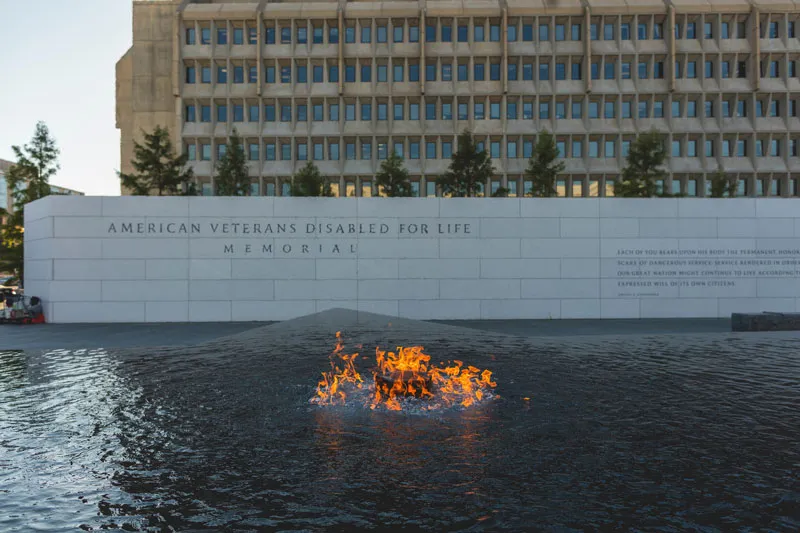
Visiting the American Veterans Disabled for Life Memorial in Washington, DC
A visit to the American Veterans Disabled for Life Memorial is a solemn and powerful reminder of the very human cost of war. The memorial “conveys a combination of strength and vulnerability, of loss and renewal… through juxtaposition of granite and glass,” according to the National Park Service, which manages and maintains the first national memorial dedicated to disabled veterans. The memorial, which opened in October 2014, honors the sacrifice of those who were disabled in service to this country across all branches of the U.S. Armed Forces. Planning your visit to the American Veterans Disabled for Life Memorial The American Veterans Disabled for Life Memorial is located just east of the United States Capitol and the United States Botanic Garden. The most convenient way to get to the memorial is by taking the Metrorail. The two closest Metro stops are Federal Center SW and Capitol South, both on the Blue, Orange and Silver lines. If traveling by bus, take DC Circulator’s National Mall route or ride Metrobus routes 32, 34 and 36 or P17 and P19. Note that street parking is often limited in DC. Be advised that the memorial is not regularly staffed by National Park Service Rangers. To find out when rangers will be present to assist visitors and provide interpretive programs, check out the National Park Service’s schedule of events. What does the memorial represent? As you wander through the nearly 2.5-acre memorial, you’ll notice many beautiful and serene features that lend to the memorial’s contemplative and reflective aura. The centerpiece of the memorial is the star-shaped fountain and triangular reflecting pool with a ceremonial flame at the center of the star. Tributes and stories of servicemen and women are told through 48 etched glass panels featuring photographs and quotations, and four large bronze sculptures. According to the National Park Service, these features “help interpret the challenges and feelings of the disabled veteran: call of duty and pride in service; trauma of injury; healing; and renewal of purpose.” How did the memorial get built? While the American Veterans Disabled for Life Memorial didn't officially open to the public until October 2014, Congress approved the memorial in 2000 and the Disabled Veterans’ Life Memorial Foundation was charged with raising the funds necessary for construction, maintenance and preservation. After a decade of fundraising, the official groundbreaking ceremony was held in November 2010 and on October 5, 2014, former President Barack Obama helped open the memorial to the public.
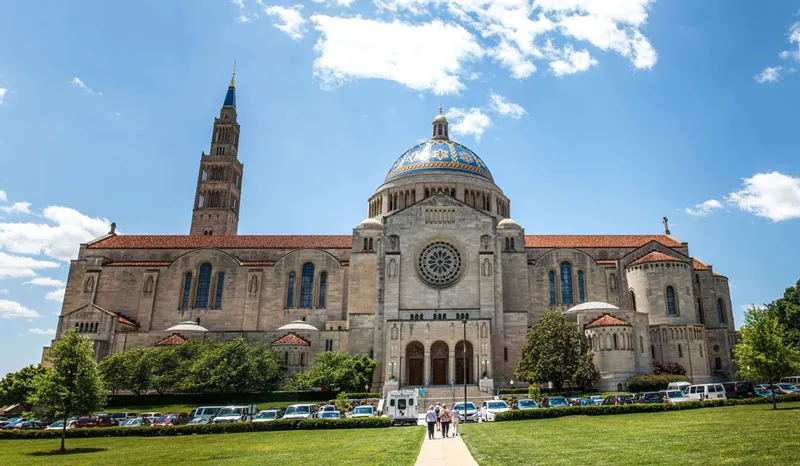
Visiting the Basilica of the National Shrine of the Immaculate Conception
Mother Teresa, Pope Francis, Pope John Paul II and other religious figures have visited the National Shrine of the Immaculate Conception, paying tribute at the largest Roman Catholic Church in North America, and the 10th largest in the world. With its dozens of chapels devoted to the Virgin Mary, an upper church that can accommodate 10,000 worshippers and soaring central dome, it’s a site inspiring both faith and awe. The Basilica's Architecture Construction began on the shrine in 1920, and continued through 1959. Built to resemble great European churches, but in a distinctive neo-Byzantine style, the structure is supported by columns and masonry but no steel beams. The impressive, jumbo-sized structure holds 70 chapels saluting the Virgin Mary, making it one of the country’s most prominent Maronite houses of worship. Chapels surrounding the upper church and the crypt pay tribute to incarnations of Mary from a variety of cultures, many of them representing the immigrants that made America. Look for a serene sculpture of India’s Our Lady of Fatima and a bright mosaic representing South America’s Our Lady of Guadalupe. Other Byzantine-style mosaics decorate many of the chapels, domes and walls. The largest and most striking is Christ in Majesty, a 3,610 square foot image image of Jesus in red and gold located in the North Apse. On the crypt level, you’ll find more chapels and a small museum holding papal artifacts including Pope Paul VI’s Coronation Tiara and a golden rose that Pope Benedict XVI bestowed on the Shrine when he visited in 2008. Throughout the Basilica, you’ll glimpse the world’s largest collection of contemporary ecclesiastical art including statues, paintings and other mosaics. Visiting the Basilica The Basilica is open 365 days a year, hosting nearly one million visitors every year. It offers masses and confessions daily as well as guided tours. Sundays at 6 p.m. in July and August there are free concerts on the twin M.P. Möller organs in the Upper Church. On the crypt level, a gift shop, a bookstore and a cafeteria also cater to visitors. Discover the best things to do in the Brookland neighborhood or check out the city’s other famous church, the Washington National Cathedral.
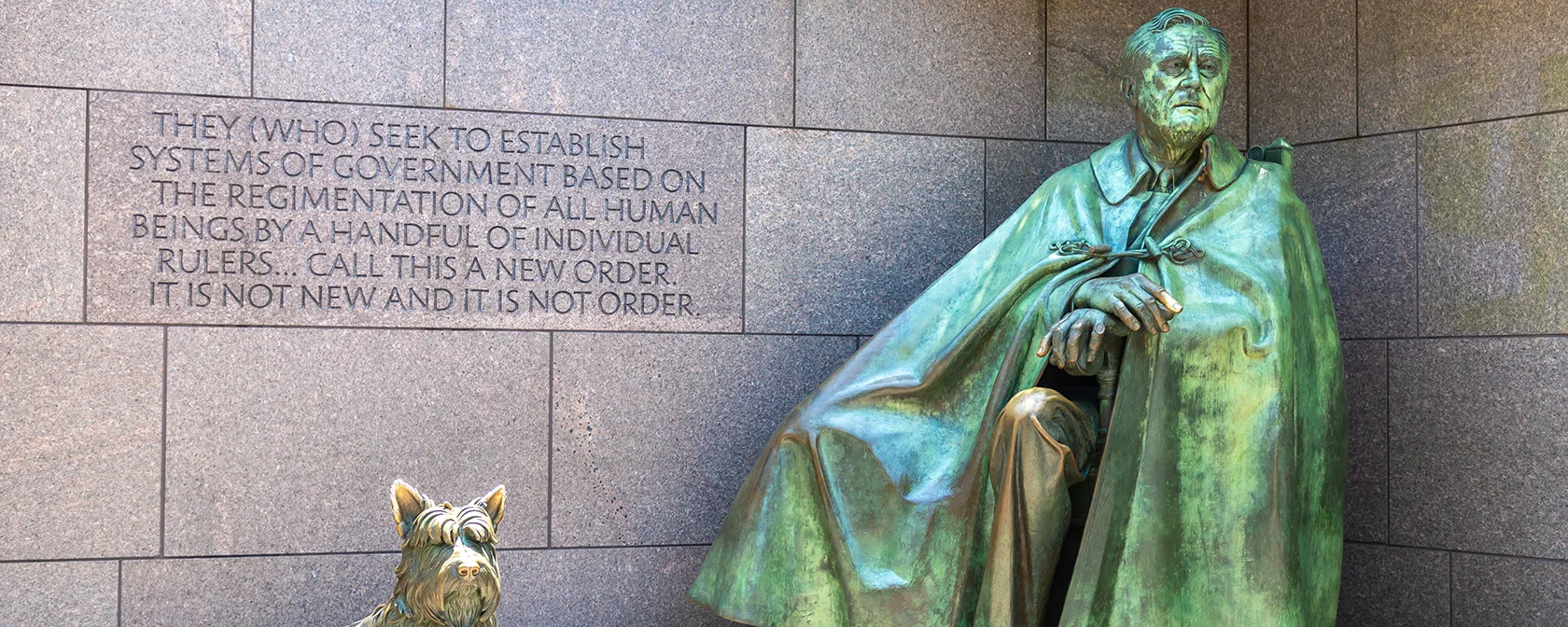
Visiting the Franklin Delano Roosevelt Memorial in Washington, DC
A visit to the Franklin Delano Roosevelt Memorial is to be transported to a trying time in American history, an era rife with economic depression and international conflict. The memorial, which honors the 32nd president of the United States, is composed of four “outdoor rooms” which represent each of President Roosevelt’s four terms as commander in chief. Bronze sculptures of the president, First Lady Eleanor Roosevelt, his trusty canine and First Pet Fala, as well as scenes from the Great Depression of fireside chats and waiting in bread lines are surrounded by engravings of 21 famous quotes and waterfalls cascading over red South Dakota granite. The memorial provides an in-depth experience and unparalleled insight into the trials and tribulations of America’s longest-serving president. Planning your visit to the Franklin Delano Roosevelt Memorial The FDR Memorial, which is located along the National Mall's Tidal Basin in between the Martin Luther King, Jr. and Jefferson memorials, opened to the public in 1997 and is maintained by the National Park Service. Like all the monuments and memorials on the National Mall, the FDR Memorial is free and open to the public. The memorial is also the first on the National Mall to be built wheelchair accessible. Given its location on the Tidal Basin among the cherry blossom trees, it is especially popular to visit during the National Cherry Blossom Festival. The most convenient way to get to the memorial is by taking the Metrorail. The two closest Metro stops are Federal Triangle and Smithsonian, both on the Blue, Orange and Silver lines. If traveling by bus, take the DC Circulator’s National Mall route. If driving, visitor parking is available on Ohio Drive, between the Lincoln and Jefferson memorials. Handicapped parking spaces are set aside at locations on West Basin Drive in front of the memorial. Note that street parking is often limited in DC. Have a question? National Park Service Rangers are on hand to assist visitors daily from 9:30 a.m. to 10 p.m. and provide interpretive programs throughout the day and upon request. What does all the water at the FDR Memorial represent? By now you have learned that the four outdoor “rooms” are symbolic of Roosevelt’s four terms as president and what the statues represent, but what about all of the waterfalls and fountains? There are many water features, all with their own meaning. There’s the water feature comprised of one large drop, which depicts the crash of the economy that led to the Great Depression; multiple stair-like drops pay homage to the Tennessee Valley Authority dam-building project; there are chaotic falls at varying angles signifying World War II; and a still pool for Roosevelt's death. The water and more than seven acres of space to explore at the FDR Memorial provide for an educational and introspective experience you’re not soon to forget. Did you know there are two FDR memorials? President Roosevelt guided the United States through the Great Depression and World War II during four terms as president, so it’s only fitting that he be honored with a memorial on the National Mall. However, this was not his first memorial constructed in Washington, DC. Roosevelt once joked to his friend, Supreme Court Justice Felix Frankfurter, that if Congress ever made a monument in his honor, he would like it to be no larger than the size of his desk and placed in front of the National Archives. Obliging this request, Congress placed a desk size stone and a plaque in honor of FDR in that exact location. However, years later, Congress decided that this was not enough of a tribute and selected the memorial’s present day location for a much larger tribute.
Visiting the Jefferson Memorial in Washington, DC
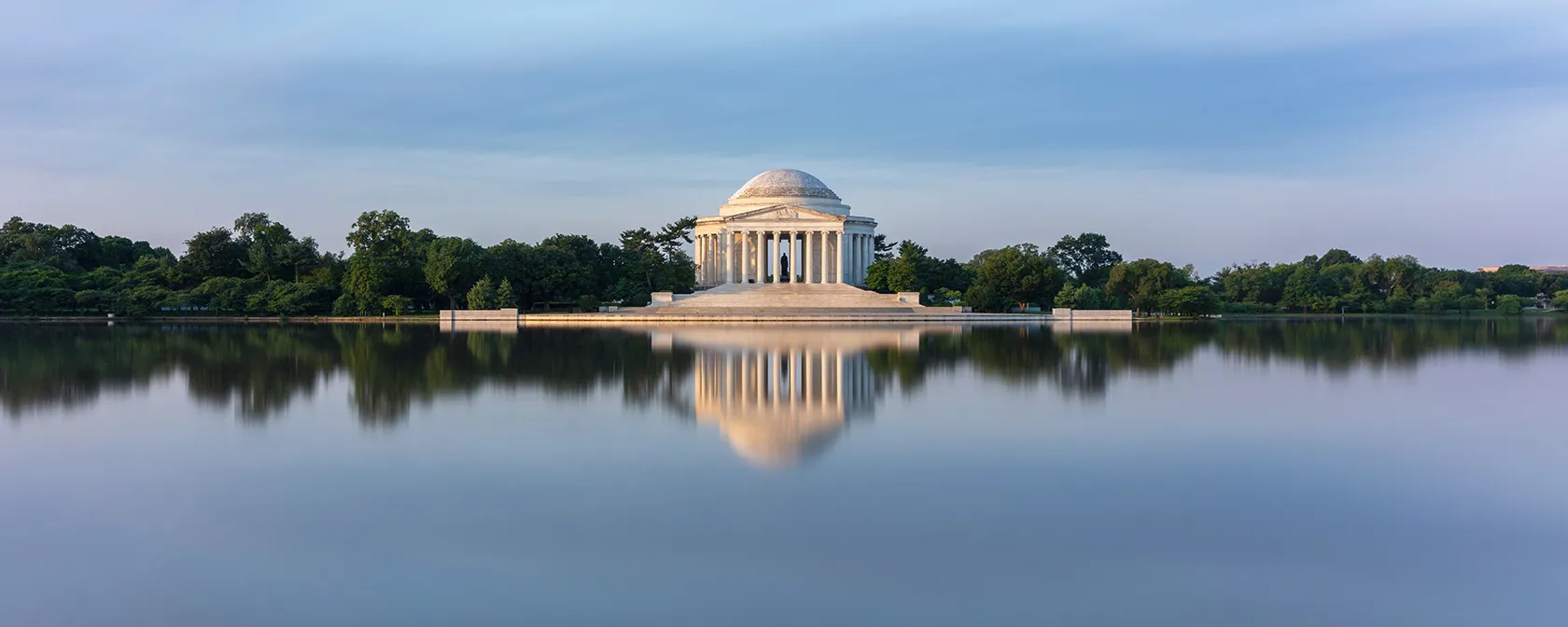
Where and what is the Jefferson Memorial? The location and architecture of the Thomas Jefferson Memorial make it stand out among DC’s amazing array of monuments and memorials. Designed by John Russell Pope in 1925, the memorial resembles the Pantheon in Rome, an adaptation of Neoclassical architecture favored by Thomas Jefferson himself. Surrounded by water, the structure is located on the National Mall's Tidal Basin, a large body of water that is bordered by DC’s famous cherry blossom trees. On a moonlit night, the memorial creates a beautiful, shimmering image on the water, and in springtime, it’s joined by blooming cherry blossom trees. What will I see at the Jefferson Memorial? As philosopher and statesman, Thomas Jefferson served in many capacities during his life: lawyer, politician, scientist, linguist, meteorologist, book collector, architect, farmer and diplomat. Of course, his two most famous posts were as the third U.S. president and the author of the first draft of the Declaration of Independence. The memorial is meant to reflect his diverse and plentiful accomplishments. The open-air, white columned structure shelters a 19-foot bronze statue of Jefferson, standing at the ready to welcome visitors. His gaze is toward the White House; the artist, Rudolph Evans, wanted the statue to represent the Age of Enlightenment, an 18th century European intellectual movement that stressed liberty and equality as natural human rights. Jefferson and his revolutionary generation fervently believed in this idea. However, Jefferson’s legacy is complicated by the fact that he was also a slave owner. The walls of the Jefferson Memorial contain words from his various texts; one expresses his idea about the right to religious freedom, while another features the importance of changing laws to represent the changing times. One of the memorial’s most powerful sights can be found on its southwest wall. On the left side of the Jefferson statue, you will find some of the most impactful words in the history of the United States, taken directly from the Declaration of Independence: "We hold these truths to be self-evident: that all men are created equal, that they are endowed by their Creator with certain inalienable rights, among these are life, liberty, and the pursuit of happiness." Jefferson Memorial hours and directions The Jefferson Memorial is open 24 hours a day, every day of the year. Rangers are on duty from 9:30 a.m. to 10 p.m. daily. The most convenient way to reach the memorial is by Metrorail or Metrobus. The closest Metro station is Smithsonian, located on the Orange, Blue and Silver lines. As for the bus, take either the 32, 34 or 36 routes.