All Articles

Success Stories
See a selection of past bids won by our local ambassadors. Lions Clubs International Convention Meeting Year: 2027 Attendance: 25,000 Ambassadors/Local Host: Lions Clubs Multiple District 22 (championed by Joe Gaffigan, Charlie Kearse, Clement Kusiak) International Federation of Societies for Surgery of the Hand Triennial Congress Meeting Year: 2025 Attendance: 2,500 Local Host: American Society for Surgery of the Hand International Society for Hip Arthroscopy Annual Scientific Meeting Meeting Year: 2024 Attendance: 700 Ambassador: Dr. Andrew Wolff World Congress of Pediatric Cardiology and Cardiac Surgery Meeting Year: 2023 Attendance: 5,000 Ambassadors: Dr. Gil Wernovsky and Dr. Jeffrey Jacobs Association for Computing Machinery Special Interest Group on Knowledge Discovery and Data Mining Annual Conference Meeting Year: 2022 Attendance: 2,000 Ambassadors: Dr. Hemant Purohit and Dr. Aidong Zhang Congress of the International Society for Forensic Genetics Meeting Year: 2022 Attendance: 1,500 Ambassador: Dr. Christian Westring World Science Fiction Convention Meeting Year: 2021 Attendance: 5,000 Ambassadors/Local Host: Baltimore-Washington Area Worldcon Association, Inc. with Co-Chairs Colette H. Fozard and William Lawhorn International Astronautical Congress Meeting Year: 2019 Attendance: 4,000 Local Host: American Institute of Aeronautics and Astronautics World Gas Conference Meeting Year: 2018 Attendance: 8,000 Local Host: American Gas Association As you can see, Washington, DC attracts international meetings of all sizes. Learn more about these success stories from some of the Ambassador Circle representatives themselves in these testimonials.
Sustainability at the Walter E. Washington Convention Center
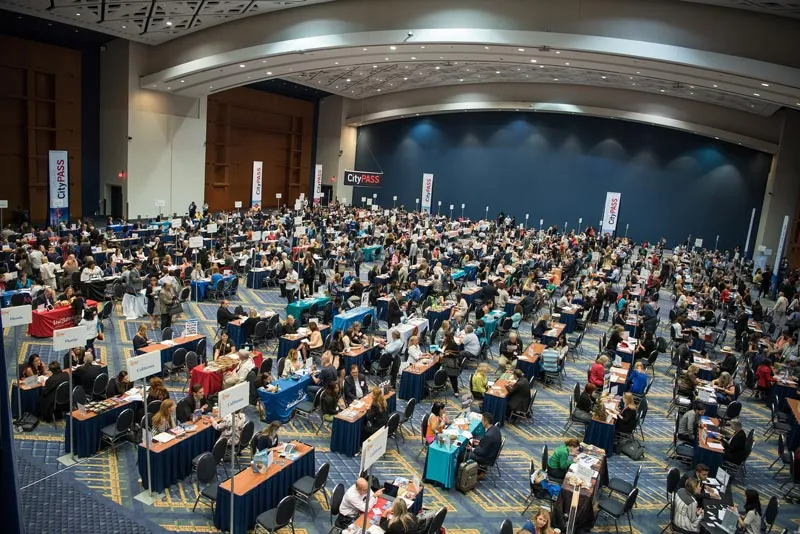
The Walter E. Washington Convention Center is a leader in environmental stewardship and sustainability initiatives, which include a color-coded recycling program, water efficiency, green product purchasing and more. The building boasts a long list of energy-reducing features, from low-emission glass to computerized HVAC systems. The center is Metro accessible (Green and Yellow lines) with a dedicated Mt. Vernon-7th St-Convention Center stop and immediately walkable to Shaw's booming restaurant scene and downtown's museums and nightlife, as well as the National Mall. Waste Minimization The “Know the Code” color-coded recycling and waste minimization program has helped the convention center take the lead on extensive recycling initiatives and effectively employing environmentally responsible products. Through a PepsiCo partnership, PepsiCo’s recycling “dream machines” were installed surrounding the center to encourage beverage container recycling rates. They are also installed surrounding the new Apple flagship store, located in the Carnegie Library. The convention center proudly recycles daily, utilizing single source haulers for recycling, carboard bailing and compost. Partnerships The convention center partners with many local sustainable businesses including DC Central Kitchen, Capital Area Food Bank and the District of Columbia Department of Public Works to recycle pallets left by decorators. An average of 50 pallets are picked up per month. Sustainability Initiatives Throughout the Convention Center All paper products throughout the convention center are made from 100 percent recycled fiber, ECOLOGO Certified (certified for reduced environmental impact) and compostable verified by an independent verification organization. This includes hand towels, seat covers, tissue rolls, napkins, food holders, utensils, cups and more. The center recently engaged a lighting consultant and is in the process of replacing all lights with LEDs, which has resulted in rebates from DC Sustainable Energy Unit for its commitment to sustainable upgrades. Events DC, the owner and manager of the convention center, has installed a solar film on large glass windows as well as a bird film on bridges that has reduced the number of injured birds by 100 percent. Chemical bottles used to clean the convention center are refilled using a self-diluting dispenser to prevent waste and spills. Chemicals are then distributed onto color-coded rags as opposed to being sprayed on surfaces or into the air. The center operates its Building Automation Systems (BAS) heating, ventilation and air condition (HVAC) in “economy” mode whenever possible to utilize outside air for free cooling or heating. Operating the building-wide lighting from a central processor also allows the center to use minimal emergency lighting during slow periods. The center continues to add to its sustainable initiatives. Events DC recently purchased seasonal boilers that are being installed to operate heating needs with far less British Thermal Unit (BTU) output during shifts in seasons. Seasonal chillers will be purchased in 2020. Find out how you can take your meeting, event or convention to the next level at the state-of-the-art Walter E. Washington Convention Center.

Sustainable Meetings
The nation's capital has built a path towards greener living and meetings with more LEED-certified buildings than any other city in the U.S. and an accessible environment where every government building is powered by renewable energy. With a goal to achieve 100 percent renewable electricity by 2032, the Clean Energy DC Omnibus Amendment Act, passed in December 2018, is some of the most aggressive, fast-acting climate change legislation in the U.S. Read on to learn how DC has become a leader in sustainability, helping its businesses reduce their carbon footprints and sharing a common vision for a sustainable planet. Connect with Destination DC staff, submit a meetings RFP or learn more about sustainable meetings and conventions in our sustainability white paper. Accolades #2 U.S. city with the most ENERGY STAR certified buildings (U.S. Environmental Protection Agency (EPA), 2022) #3 Greenest City (WalletHub, 2022) 1st LEED Platinum City in the World (U.S. Green Building Council (USGBC), 2017) More LEED-certified buildings than any other city in the U.S. (USGBC, 2022) #3 among North American cities for sustainability (Corporate Knights, 2022) #10 for Greenest Cities in the world and #1 among cities in North America (Resonance, 2022) Access Seven universities with significant credentials in sustainability both in terms of courses offered and in terms of a cross-department and connections to industry and key policy institutes. More than 50 associations, policy groups and advocacy organizations in the metro area focused on sustainability. U.S. Green Building Council (creator of LEED) is headquartered in DC. The Department of Energy and Environment (DOEE) is the leading authority on energy and environmental issues affecting Washington, DC and employs approximately 300 engineers, biologists, toxicologists, geologists and environmental specialists. Local Support The District of Columbia government is committed to sustainable practices affirmed by its commitment to the Paris Climate Agreement, and its course to meet its target of reducing greenhouse gas emissions 50% by 2032 and to become carbon neutral by 2050. The Clean Energy DC Omnibus Amendment Act aims for the city to adopt a Net Zero Energy building code by 2026, improve energy efficiency of existing buildings and reach 100% renewable electricity by 2032. The city has a growing fleet of electric buses (14) and public curbside chargers. DC hosts an annual Open Streets event where three miles of roads are closed to vehicular traffic and opened to pedestrians. Several roads have become pedestrian-only post-pandemic, including Beech Drive within Rock Creek Park. These efforts demonstrate how roads can be used as vibrant public space with minimal impact to traffic. Edit media The District has 78 miles of protected bike paths as of 2022. Washington, DC maintains all public trees. The urban forestry department sits within the transportation department and manages trees in parks, schools and public land. DC's urban tree canopy equals 38.7%, the city's goal is to reach 40% by 2032. Mayor Muriel E. Bowser is a member of the Global Covenant of Mayors for Climate & Energy. The Clean Energy DC Omnibus Amendment Act, passed in December 2018, was the nation's first 100 percent renewable energy bill and the most aggressive, fastest-acting climate change legislation in the country. Washington DC is part of the C40 initiative, a group of 96 cities worldwide dedicated to finding evidence-based and bold climate action solutions. The DC Green Bank is an innovative policy tool that will use public purpose funding to attract private investment and finds solutions that prioritize making the clean economy inclusive and affordable for residents, businesses and communities. DC Green Bank focuses it investments on solar energy, greener and more efficient buildings, infrastructure resilience and transportation electrification. Cities100 is an initiative shared by sustainability think tank Sustainia, C40 (a group of global mayors) and Danish philanthropic agency Realdania to find the 100 leading city solutions to climate change, three of which are from Washington, DC: DC introduced low-cost memberships as part of its bike-share program to ensure that healthy, green transport is widely available. DC applied Property Assessed Clean Energy (PACE) financing to a local affordable housing project, saving the property money as it promotes climate and energy equity. The largest thermal hydrolysis installation in the world helps DC produce bioenergy more efficiently while turning waste into a productive resource. Innovation Innovations have transformed the city into a living lab of sustainable policies and innovative technologies that seek to advance social, economic and environmental priorities that carry global relevance. Thirty domestic and international sustainable startups in the metro area such as Clean Choice Energy and Arcadia Power Potential Energy DC, is an incubator of 18 organizations dedicated to propelling energy and sustainability startups in the DC region. American Geophysical Union’s 62,000-square-foot headquarters is the first-ever net zero energy renovation of an existing building in DC. American University in Washington, DC is the first urban campus, the first research university and the largest higher education institution in the U.S. to achieve carbon neutrality. Discover the DC Sustainability Guide, your green travel resource for Washington, DC’s sustainable hotels, eco-friendly attractions, locally sourced food and more. Interested in learning more about Washington, DC as a leading destination for industry meetings? Connect with Destination DC staff for more information or read our sustainability white paper.